Layering various cloth weights for added strength?

I have a similar impact jig and if we want to get REALLY technical a collegue of mine in Portugal has a fully instrumented impact machine measuring responses in the millesecond range!

However I’m happy to do some tests and will drag out some glass and make a few samples.

Question??? Is it tensile strength, modulus, flexural rigidity, flexural strength that we are all interested in? The easiest to measure quickly for me is tensile strength (and modulus) and flexural modulus. These measurements will be for the laminate only, not a cored sample. I can do cored stuff for cores up to about 15mm, after that the skins fail by local compression (pressure dings in the deck where the feet go) long before any other failure mode takes place.

My supplier only seems to do 4 and 6 oz cloth and I’ve ordered some samples for testing, anybody in UK got any 2oz cloth they can send me and I’ll test that as well…

I have a tip for you.

Dont pretend to have any idea what you are talking about.this palce is already too full of posers who wear shaping like a heart on there sleeves.Get your own identity…we all see thru you like a window.get an idetity

Improve your grammar, punctuation, add your status, location and other information to prove you’re not one AND don’t call me a poser!!! I have nothing to hide!! Except my ignorance?

Rikds,

I’m sure there are some non-poser, real shapers here on Sway’s that are more qualified to answer your questions than I am. After all, as I’ve always posted, I’m no expert, I’m pretty new to this. I’m just trying to make sure I don’t get Mr. Kallaway on my tail by pretending I’m more than I am. But it’s good to see that Swaylock’s has implemented Poser Police. It’s long over due. What with all the crazy pretending and stuff. Well, I suppose it’s possible that Sway’s didn’t implement it and Mr. Kallaway has nominated himself to be the Poser Police, but then that would be kind of wierd, and nobody likes to be wierd. Do they?

It is my very humble and non-expert opinion. WAIT A MINUTE! If I spent 10 years doing distructive testing, I think I have something to say here without being a poser. Anyhow, I’d think tensile, modulus, and flexural rigidity are the key players in surfboard performance, and impact resistence is a key player in durability.

Hi,

Please take a peek at the following references, if you haven’t already,

Structures or Why Things Don’t Fall Down, J. E. Gordon, (1978) ISBN 0-14-02-1961-7

The New Science of Strong Materials or Why You Don’t Fall Through the Floor, J. E. Gordon, (1976, 2nd ed.) ISBN 0-14-02-0920-4

On that note, though my question (below) may appear to be an attempt to highjack the thread, it’s actual intent is just to back it up a bit.

The following eventually leads to a way of estimating breaking strain. Some preliminaries are required, if only to make sure we are speaking the same language.

Preliminaries

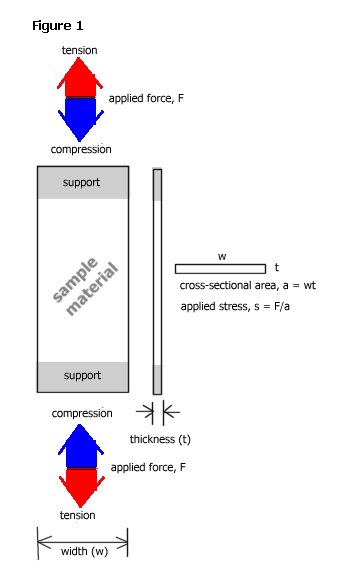
First some definitions: stress (s) is force per unit surface area, and will have the same units as pressure; strain (e) is the ratio of change in length to original length, and has no units, its a pure fraction. For many materials, least when the strain is small (somewhere around 1%, usually less, but sometimes a little more) the ratio of s/e (stress to strain) is constant and is called Young’s modulus –i.e. s/e = Y. Young’s modulus is also known as the modulus of elasticity, and possibly by a few other names too.

Young’s modulus is not a bad indicator of ‘stiffness’ when used correctly, but ‘stiffness’ as it is commonly used, often involves both Young’s modulus and geometry. The reason being that it is often used in reference to force rather than stress, e.g. the restoring force of a spring or wire is classically given by F = -kx, where x is the extension of the spring and k is the stiffness constant. I’ve mentioned this with the hopes of avoiding confusion.

The ultimate tensile strength (UTS) of a material is that minimal stress at which the material will fail. It is important to understand that here the reference is to a material, not a structure. Obviously, when testing materials it is impossible to not consider structure, it’s just that the protocols for testing have standardized structure so that to the extent possible, structure as a factor is eliminated. Therefore UTS is a best estimate (given the constraints) for the stress at which a material will fail.

This next statement will likely cause some controversy. When considering a composite, like fiberglass/resin, the resin plays a very little role with regards to strength –i.e. virtually all of the strength comes from the fiber, and for fiberglass composites that’s glass.

Before continuing, an additional note on terminology; strength is one thing, toughness is another. You can have a very strong material, but a brittle one, and therefore somewhat useless for certain applications. Toughness is what makes composites unique and valuable – i.e. their ability to handle cracks or fractures without totally failing. Perhaps this thread may migrate towards a discussion of toughness strategies, but right now it seems to be about strength. The point being that toughness and strength are two different engineering concepts and confusing them can get you in trouble.

Glass

The Young’s modulus of glass is something around 60 GN/mm (that’s 60 giga-newton per meter-squared). The ultimate tensile strength of glass is around 1 GN/mm (that’s 1 giga-newton per meter-squared). This puts a UTS-strain at e = s/Y, e = 1/60 = 0.017 ~ 0.02 or 2%.

Recalling that e is the ratio of change in length to original length, then if the longitudinal bottom length of a surfboard is L, it would have to suffer a change of eL in length before some of the glass fibers might start to fracture –i.e. e = (change in length)/L, then (change in length) = eL.

The Question

Here’s my question, what’s the bottom length of your surfboard and what’s its wide point width? Using the above crude calculation to estimate the required changes in length or width before fracture, how often are such changes in length observed?

The geometry of the board will come into play, but assume the simplest case. Also, its assumed that when using the composite the weave is aligned such that it is roughly perpendicular and parallel to the stringer or centerline of the board.

Loaded?

The question isn’t loaded, but there are other issues which have to be factored in. One in particular is pre-stressing. For some composites, like fiberglass/resin the volume shrinkage upon curing can be up to 7%, which sort of translates into a lengthwise shrinkage of up to 2%. This isn’t purely tensile, but it is likely to pre-stress the lamination. Perhaps the thread may wander around to addressing pre-stressing, but right now it seems to be about strength.

Strength has its benefits, but it has it also has its costs. The question, at least for me is, given the application, what is the appropriate level of strength required. Or more precisely, what is the appropriate mix of strength and toughness.

kc
I knew we’d get really technical on this one!! The books referred to are excellent, especially “The New Science of Strong Materials”. Its the only book on materials science I’ve ever read that puts a mind mangling science into reasonably plain English.

My take on all this is to treat the board as a beam in bending. If we consider simple three point bending and, for example, support the bottom of the board near its ends and apply a load to the centre of the deck, at its simplest the deck sees compressive loads and the bottom tensile loads. In theory the core (foam blank) suffers mostly shear loads.

Obviously if the tensile strength of the bottom, the compressive strength of the deck and the shear strength of the foam is enough then the board won’t fail for a given load. The effect of the rails and stringer will also be significant in resisting bending. As a rule I believe that thin skinned, cored panals like this usually fail in compression and buckling long before tensile failure occurs.

The problem in all cases like this is to model realistic loads as one rushes down the wave face when the lip and most of the ocean lands on your head, tumbles you around for what seems forever and then spits you out. All that power that thrashes you around is worse for the board as it is a more rigid structure than you, at least you bend and twist which helps dissipate the forces…That’s a bit of a give away, I’m not very good and get eaten by rude waves on a fairly regular basis!

This is why I’d like to do the tests, I do materials and stuff as well as build boats. To make the samples as representative as possible this is my proposal, if its wrong (or just plain crap) let me know (I know somebody will)…

Using as many different weights of glass as I can get my hands on samples prepared the same:

One set with polyester, one set with WEST epoxy (its what I use for boats).

All samples post cured at 50C for 8 hours. (Is this one really necessary?)

All samples resin infused to get optimum resin/glass mix with minimal bubbles (none in theory!)

Tensile and 3 point bend tests along axis of fibres and at 45 degrees to fibre axis

If somebody can send me some foam samples I’ll do some flexural tests on glassed foam laminates.

I’ll put up the properties and a structural engineer out there can do the maths, it’s way beyond me.

What’s the point in having all this kit available if I can’t put it to some really useful employment?!

SO is this any good??

Quote:

This next statement will likely cause some controversy. When considering a composite, like fiberglass/resin, the resin plays a very little role with regards to strength –i.e. virtually all of the strength comes from the fiber, and for fiberglass composites that’s glass.

ahem…what TYPE of strength? Tensile? Compression? As usual Kevin, youre looking at one biased aspect of the ‘analysis’. Not really sure why you do that…you seem intelligent enough…maybe you prefer playing mind games. Youre analysis is ass-backwards. Ever thought about doing a FMEA on surfboards? You might learn something lots more usefull than the stuff in textbooks.

Excellent.

Perhaps things will be different, but I’d bet manufacturers would be willing to part with some samples if they understood the project (a Swaylocks born one, the results of which to be published on Swaylocks) - and I would love to help, however I can.

You’ve already begun by suggesting some interesting protocols, which is a reasonable first step - and it might be wise to persue this a little more first. Then after we have the protocols -i.e. tests and ways to do them, and a reasonable list of materials and structures to test we can then work up a list of manufacturers and petition them for samples (all of which I would love to help with.)

So, for example we might consider developing another kind of test that will tell us something about ‘working’ a material i.e. how much a material can be bent, twisted, etc. at relatively low stresses, torques, strains, etc. before failure, that is, how much a given amount of ‘working’ impacts strength. This is quite different from ultimate tensile strength and probably is more important in the long run.

Sounds exciting. A little organization will be key, as well as getting everyone (interested) to agree upon some commonly standards (which will hopefully be meaningfull to board builders.)

One more thing, do you have a camera so that we could catalog cracks, creep, fractures, etc., not to mention everything else?

kc

All right, I’m not to sure the “As usual…” was called for, but here my use of the term strength was with reference to tensile. I had assumed that my reference to the ultimate tensile strength (UTS) sort of set the context, but your point is taken.

Actually as for my point being ass-backwards, this I don’t see.

What surfers and builders commonly see is strain, or at least extension, which directly corresponds to strain. They don’t see stress. They may have a rough sense of ‘force’, but it’s usually not all that quantifiable, at least not to the same degree that an apparent change in length or deflection are.

As for FMEA, I don’t see why we can’t contribute here on Swaylocks, a sort of ‘distributed’ test lab – who else better to have as participants and contributors.

As for my ‘textbooks’, you’ve got to be joking.

kc

PS

Maybe at some point you can justify the little rubs you just made. Though hopefully not in this thread; start a new one, or restart one of my old ones.

The machine I use is capable of fatigue testing in more or less any mode, however it is not a hydraulically driven beast so it cannot do high frequency tests, I’ll check tomorrow its maximum frequency. It will go to 100Kn which should be heaps!

I have a contact in Olympus who might loan me a high speed digital camara for a project like this, no doubt he’ll want some advertising out of it but we could deal with that later.

OK. Got a hold of an expert, Hank Johns at GraphiteMaster. Thank you, Hank. Hopefully I’ll convey your remarks accurately. If not, please jump in. Your expertise would always be welcomed.

WRT to weight, there is some validity to Multi-layer Lamination w/Different Weight Cloth (MLDWC). What MLLDWC seeks to do is avoid stacking weave ridges of one layer on another of the same weight, in favor of nesting the weave of one weight within the weave of a different weight. In this way you would get a tighter lamination with less resin and therefore a higher fiber/resin ratio. (My take: this is good in a perfect world, where hairs are split, but hey, if it is better and costs no more and you are building in your garage, why not?). So alternating different weight cloths in a lamination could be stronger.

WRT to strength, consider Multi-layer Lamination w/Same Weight Cloth (MLSWC). In this case, shear strength, and thus break strength is greater because there are more inter-laminar bonds. More shear strength of inter-laminar bonds is good. You would therefore expect a 3-layer lamination such as 4/4/4 to be stronger than and equivalent weight 2-layer lamination such as 6/6 because it has more inter laminar bond strength (more layers). More layers, with lamination weight held constant is stronger. (Makes sense to me).

My take: In fact, it is the ability of a 2-phase matrix to take up shear through this bonding that gives it the needed strength when individual fibers are flawed or just break in use. (Two-phase matrix composition 101)

The example that Hank gave was G10 fin stock. G10 is made up of much finer weave cloth and is much much stronger. This is required for sailboard fins where added strength is needed. Surfboard fins aren’t normally made from this G10. (My take: surfboard fin boxes usually break before the fin so G10 isn’t needed).

So, in the extreme case, a 2/2/2/2/2/2 would be stronger than a 12 oz single lamination. But no one but a nut would want to endure that project. So maybe a 4/2/4/2 for a deck would be good. If you had the time and inclination.

Wow. That’s with respect to both the testing equipment and the possibility of a high speed camera. It would be very interesting to have a visual record of an epoxy composite failing (in a fatigue or any strength test for that matter.)

Had to search the attic for it, but here is the reference for my comments regarding shrinkage: Fiberglass and Composite Materials, Forbes Aird, 1996 ISBN 1-55788-239-8. Presently, I’ve no idea if this (general comments regarding shrinkage) has changed, or how generally this can be applied to other composites. At the time (1996) the reference gave a nice survey of current composite construction methods (including epoxy based) in manufacturing.

Hopefully there will be some discussion of your protocols and tests prior to any actual testing.

Still, sounds like fun to me.

kc


List of Possible Tests (Almost stable, 10/26/06)

  • different fibers used in composite, e.g. hemp, synthetics, etc.
  • the effect of varying the ratio of matrix to fiber
  • Laminate number, various combinations
  • strength and stiffness changes with presence of gloss coat
  • difference between 4/4 and 4/1/4 where 1 is 1 oz of mat (enchance binding between laminate layers)
  • laminates made with sanding resin vs laminating resin
  • presence of pigment
  • presence of bubbles
  • strength of various mixtures used to fill holes in ding repair sugar/resin, microballs, etc.
  • strength of various chopped fiber/resin mixes
  • difference in strength between a sanded and unsanded (prior to gloss coat) -i.e. mechanically damaging laminate with sander.
  • strength of repaired sections
  • creep testing
  • 'work' testing
  • pre-stressing test - laminate prepared on frame (stretches when cured) vs unstretched preparation

Some Preparation/Test Suggestions: (Started, 10/27/06)

  • whenever possible samples should be trimmed during green phase of cure (when razor cuts cleanly) to prevent mechanical damage to laminate(s). If not possible to trim during green phase method of trim to be given
  • whenever possible samples should be rolled to remove excess resin
  • sample width and length to be standardized
  • test repetition - three would be nice
  • temperature and duration of cure
  • sample thickness record
  • ... more?

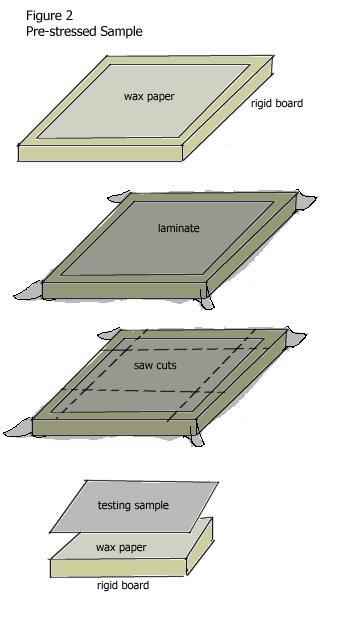
Below is a proposed way of creating a pres-stressed sample. (It would be nice if all samples where pre-stressed -i.e. cured under the tension/compression as a result of the nature shrinkage due to the curing composite - but that’s unlikely.) As for the technique illustrated below, I have problems with it. Mechanically damaging the composite (saw vibrations) is very likely unless care is taken to avoid it. As I am not an engineer and have no experience with developing practical test samples, hopefully you might have a reasonable solution.


Very nice.

I am curious, did he say there would be a noticeable increase in ‘breaking’ tensile strength with between 4/4/4 and 6/6, or just that it would make for a noticeably tougher material (-i.e. take more punishment before failure)? Also did he say anything about the differences in apparent stiffness when used structurally (which relates to my first question)?

Sorry to parse my questions, but I’d like to know how ‘strength’ is being used here. Does stronger mean ‘stiffer’, which would also mean different response characteristics to vibrations etc.?

kc

Added.

By the way, did he say anything about the way epoxy composites fail? Do you know if he would make himself available to answer such questions?


Quote:
I've got the kit available, you tell me the laminate schedules you're interested in and I'll make samples, break them and post the results. My students love this kind of stuff!!

Rikds,

Let me just say that you are very generous for offering to do this testing. This is something I’ve wanted to do for a very long time but didn’t have the time or testing equipment. I’m looking forward to seeing your results.

One test that I have been looking for but have never heard anyone try is regarding springback speed. For example, given laminates with the same modulus, but made from different materials and observing any difference in their return speed after being flexed. I’m wondering if you have heard of such a test.

Thanks,

Ken

Quote:

And Doc, where are you? And the boat people.

Ahmm - I have been a mite preoccupied with one of the boat people, actually. Female and exceedingly lovely and, like myself, into wood boats. And even more dear to me than this technical question, and that’s saying a lot.

But let’s have a look at the thread as a whole, and the overall problem of surfboard construction. Bear in mind that not only am I coming to this late, I’m also coming off an abscessed tooth and a couple of glasses of White Truck White. So my analyses may well be flawed.

First off, I am gratified to see some real drive towards testing, with numbers. While a sophisticated, talented and trained hand and eye can tell a great deal, we don’t all have those or the opportunity to develop them. Rikds has some lovely thoughts as to testing, though if I may, I might add a few of my own in a bit. The high-speed digital camera especially, 'cos it’s not only important to know relative failure strengths but how they fail.

While I haven’t done any tests with various resins and cloths, my friend patrick made up a number of test pieces with glass cloth and carbon fiber and varied the resins. It was quite interesting: the varied resins, even epoxies, had very different stiffnesses. And the stiffness of the item in question is important, 'cos as kcasey rightly points out, it’s not all about tensile strength. If the lamination doesn’t possess a certain amount of stiffness in the Z direction (see ‘vectors’ in the diagram to follow) it’ll delaminate and fail, or catastrophically fail under impacts like a thick lip. This also has implications in compression failure. (edit - sorry, Rickds, I neglected to look at your post full before I blathered on - you more than anticipated my meanderings)

And what else? Well, the foam-laminate bond is important. All laminates have some bendability to 'em. And the tradeoffs of stiffness in a board versus ‘feel’ and response to the wave are of some importance. But too little stiffness leads to delams and failure. And the stiffness is mainly a property of the resin, if patrick’s test pieces are any indication - and pat, chime in if you have the time, I know you’re busy just now.

So, a couple of suggestions, with my customary crude sketches:

So, test sections. I’d suggest that a foam/fabric/resin section be used in failure testing, with a ‘D’ cross section to replicate (approximately ) standard surfboard cross sections. Leaving the ends unglassed, or un-carbon-fibered as it were, shouldn’t be an issue if the test article is long enough. Moreover, any foam/laminate shear exacerbated by an unlaminated end would probably be useful.

I will note/confess that ‘testsection 2’ betrays my own bias, that a stringer weakens the overall ultimate strength of a surfboard. Which I would dearly love to see tested.

as shown by this, which I doodled last June as a test piece for stringer vs non-stringer construction.

In any event, I look forward to what you gents have forthcoming… and I will also note that when I was looking for patrick on the sways member directory I noted that MTB was online. If I am not mistaken, that learned gentleman has probably done a lot of this already. With my customary utter lack of courtesy, class and couth, may I heartily invite him to this discussion.

doc…

Hi Doc, great to have another wooden boat fanatic who’s also into surfboard technology, maybe we should form a club!

I’m in full agreement with your take on the testing but I have some problems (ones that I’m prepared to talk about in an open forum!).

Yes, it would be great to test full sized sections and that would obviously be the best way to go. The problem with a 3 point bend test is point loading producing high stress points which initiate failure. The thicker sections require higher loads (flexural stiffness being a function of thickness) and thus higher point loads to get adequate deflection. I ran a test program on hull and deck sections of a mini-transat yacht we built. 15mm Airex foam Single layer Biax glass vacuumed on each side and the same foam with 2 layers uni-carbon on each side. Fantastic loads achieved (I have the figures if interested) but failure on the compression face under the load roller every time. I did get round this by using a water filled bladder under the load application plate and this seems to replicate a wave landing better than a standard 3 point test. We are building a Hydromat test setup http://www.westsystem.com/webpages/epoxyworks/14/Hydromat.html which attempts to apply a distributed load. Interpretation of results is somewhat complex and I have to get my head around the detail…SO what I’m saying in a somewhat laboured way is that testing big samples is not easy in my machine. 500mm long by 95mm wide by whatever thickness seems reasonable. ASTMD790M gives a range of span to thickness ratios (16, 32, 40, 60 :1). These ratios are critical when point loading is considered.

Next issue would be the rate of loading in a test set-up. Most of these materials have highly strain rate dependant responses, how fast is that lip travelling when it hits me? How is the board supported in water in real life? I suppose we must start somewhere and impirical values of tensile strength and flexural rigidity is as good as anywhere.

I suspect that the term strength is being used when actually flexural rigidity is what is most interesting ( I take flexural rigidity to be EI, modulus x second moment of area)…

AAAAAAAAAAAAAAAAAAAGH…where do we go with this?

I’m off to fix my unbreakable longboard punctured by a shortboard nose during an unsightly meeting in some heavy whitewater. My longboard being Kevlar/glass/epoxy is TOUGH and I’ve had to remove 2" of the broken off shortboard tip from the hole!!

Hi Rik,

First, I want to apologise for not being clearer. Blame it on the vino or the endorphins or plain ‘Doc has stoopid days too’ - I should have said that a scaled down section, not full sized, would be the test item of choice. Something of a ‘D’ cross section, lying on its side, with maybe the same width/thickness ratio as most boards run to - I’d call it 8/1 or 10/1 as close enough. This could be cut pretty easily using a hot wire and a couple of simple plywood templates using any of a number of the hot wire cutters and guides that have been shown and discussed.

This would give a test section that’d deform or break at more reasonable loads, I think.

Another odd thought - I have noticed that the initial stiffness of a board tends to relate to the sound it makes, going down the face through chop: the higher the sound, the stiffer the stick. I wonder if that’s somehow measurable? Almost like a tuning fork or the resonace of crystalware, if something could be made to thump the test section and produce a resonant tone at a measured frequency, well, if that could be related to the stiffness then you might have an easy test that could be run on ‘boards in the wild’ as it were. If the board resonates at X Hz, vs 1.5X, vs .5X, then that’d maybe say something about how stiff it is.

Though that may be a screwy notion…

Thinking about how to replicate or simulate the impact of a lip on a floating board gave me another strange but maybe fruitful idea. You know those air cannons that blast frozen chickens at airliner windshield mockups? Well, how about something like that, shooting a water balloon at a test section that was backed up against something like a fairly tough bag of water. Impact force could be calculated by getting the muzzle velocity of the water balloon ( such chronographs are fairly cheap, seems like every gun writer has access to several - and they don’t pay them all that much) though I dunno if they’s handle something the diameter of a reasonably heavy water balloon.

Test to destruction, jacking up the velocity/air cannon pressure until the test section broke, have the high speed camera behind a reasonably healthy piece of Lexan or something, and you’d have at least relative strengths and also a good handle on how boards break?

That make any sense, without being too ‘blue sky’?

doc… hangover fading, fortunately…

Hi,

If your inclined, would you describe your testing machine(s), sample sizes, etc., in particular what information about the test will it make available - or, you can just send me somewhere on the Net to read up on your setup.

kc

Hi Kevin,

The machine is a Lloyds Instruments 100KN something something made in UK. The software is by Nexygen.

I’ll post some pics if you want and a copy of the data output, its pretty comprehensive. Have to wait 'til next week, half term here and am trying to find some waves when not doing domestic duties (leaf clearing, shed / workshop building, delivering son to work at surf school, all the usual stuff).

'Til next week, cheers

Again, Wow. That’s a nice machine.

http://www.davenport-instruments.co.uk/

Recommendations for those curious as to what the machine does:

(attention: Rikds. If the above video does not represent the kind of application that will be performed, would you please point us to the one which does.)

I’ve tried to narrowed down the list of tests I’d be interested in (see above post.) Please take a peek at the list and get back to if you are interested in performing any of them, or any variation of any given test. (I understand the fact that its completely your choice.) If any of the tests do interest you, I would then like to discuss standardizing preparations. Hopefully, at some point others on the forum will start to weigh in with other tests or refinements of whatever is eventually proposed.

If getting the materials together is a problem, please allow me to assist you. I’m not a wealthy man, but I am guite willing to communicate with manufacturers to try and get them to send you some samples. Back in the 90’s when I was exploring other foams and composites, many of the companies I communicated with sent me samples. Though some of the sample packages may not have had the proper quantities to perform these kind of tests, perhaps they would be willing to add a little extra.

By the way, no hurry… at all.

In the end I’ll likely be gratefull for whatever tests you perform.

kc