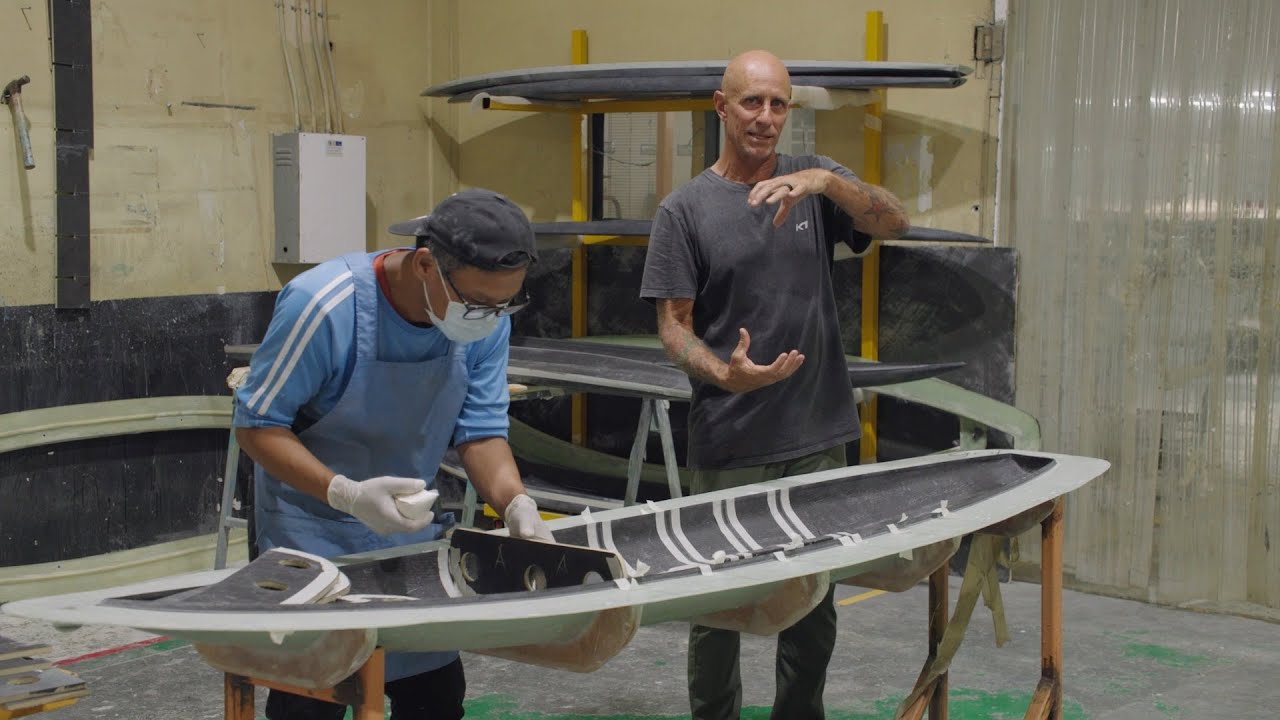
Open cavities fill with water quick and drain poorly/slowly — a lot more than enters a ding in a glassed, solid EPS core. XPS won’t absorb water and the cavities can be drained when it is convenient.
Yes the problem with EPS is water absorption. But for some builds I have no other option.
XPS and EPS are made from the same material (polystyrene) with same surface energy. The bonding issue is related to closed cell foam vs. foam with interconnecting passages. The most common error building with XPS is using low density XPS. XPS requires special surface prep and the right density. Search past threads — I have discussed this many times now.
A few short, quick threads. I have done several other more detailed discussions over the years.
Perforated XPS requires an epoxy pre-seal before laminating.
For DIY airplane Rutan’s build, guys use xps with glass hand lam over. The “right”xps called spider foam from dow chemical seems to not have delam problems like those who try standard insulation home xps. So some xps is better than other for sure.
On other hand in europe there is kite/wing builders that use a denser xps foam with glass and carbon over. They have good reviews but some boards suffer major delam, i had some to repair, delam start at an impact then spreads quickly. Same problem i had with my xps rails board i made 15 years ago. I see that some of them recently come back to eps core.
Xps is sensible. You can find many success with, mostly hobby builds, and many disaster because when it start delam it’s the end. Xtr find an industrial solution with punching holes to prevent delam spread. I heard a kite foil builder that have no problems with well build pvc sandwich skin over xps. Xps seems to be hazardous way for me but i still use it here an there as center stringer for widen eps blanks. Pu glue stick well on it, 40 grit then epoxy+microfiber well spread before lam. I also notice that epoxy stick better on hotwire cut surface after good prep. May be, like with other plastic, torch flame prep should be effective but a bit funky to do LOL.
@lemat I have read that heat treatment of low surface energy plastics can improve bonding with adhesives. Pretty sure the heat lamination of boogie board components relies on this. Perhaps something as simple as using a clothing iron at the correct temp could achieve better bonding of XPS with epoxy and/or other adhesives. Seems risky without a lot of experimental trials first.
I still say cork sandwiched between fiberglass skins over epoxy pre-sealed, properly perforated XPS of high enough density; laminated and fill-coated with opaque white pigmented epoxy will make a board that is durable if not exposed to extreme temperatures.
The first properly perforated, pre-sealed XPS core (1.5 pcf) bodyboard I glassed with 6/4-6/4 FG and opaque white pigmented epoxy is still fine. I only use it as the top board for strapping down my stack of XLPE Paipos and standard Boogie Boards to prevent the straps from permanently grooving the unglassed, soft, closed-cell foam boards underneath. The last round trip was 28 hours of driving in the hot, summer-solstice sun (directly over head) with regular stops in exposed, asphalt parking lots for meals and gas/restroom pit stops (4 passengers). The top, white XPS core BB took all of the direct exposure to solar heating (radiant heat gain) and ambient air temp. No de-lams yet. (I would not recommend any XPS Core board be treated this way.). Add cork FG sandwich skins with opaque white pigmented epoxy — thermal insulation of the XPS core and impact absorption should be even better.
Important but not addressed in this thread, large air filled cavities should be inter-connected and vented so that internal pressure changes due to heating (especially) and cooling can be equalized.
Finally, XPS construction techniques should be careful and meticulous.
EDIT: Many years ago a Sways member recommended wiping down the XPS surface with DNA. Since then if I use XPS, I wipe down the XPS foam slab with 90% Isopropyl Alcohol followed by a wipe down with a distilled water wetted (clean) cloth after the alcohol evaporated — before I begin shaping.
I am a big fan of cork sandwich too. More i use it more i improve my build. I build race windsurf with glass cork and carbon over 1 pound eps. Light, strong and though.
Glass under and carbon over and add carbon under where we stand for kite/wing and windsurf. Cork and carbon is a very good match for me, stiffness from carbon toughness from cork epoxy.
Vaccum bag for glue cork, hand lam for fiber over. If you know how to hand lam right vaccum bag lam for thin layers that have to be resistant to composed flexural stress, impact and waterproof is at least useless, most of time an error.
Assuming XPS delam can be solved with a combination of chemical/physical/thermal primer steps…
XPS under the deck/rails/fins. Could we have the rest of the board be hollow?
Would the closed-cell XPS avoid soaking up any water that makes it into a cavity?
Could we just have all the cavities connect, and single drain plug at one end?
Or, 2 drain plugs, one at each end, and you could blow dehumidified air in one port and out the other?
For me delam vulnerabilty of xps can’t be solve. But you can live with it.
If i go hollow way i would laminate both inner and outer face of xps like Salomon blue boards, wich were hollow xps.
You can do holes in inner structure so all communicate for venting. It’s what you find for all those new hollow downwind sup (starboard, naish, kt… all build more or less same hollow build tech by cobra).
But i would go with at least two independant chambers for security. A friend had an open ding on a Salomon outside reef a nightmare.
There is a construction of hollow sailboards exactly like that , but with PVC foam , not XPS. Carbon sandwiched. These are not for purely lightweight, but to maximize stiffness.
Seems Cobra is using “Nomex” and carbon skins for weight reduction as well.
Interesting that they use a white paint topcoat (minimizing radiant heat gain from the sun?).
For me, EPS water-logging from dings is a headache I would avoid if I could. But some prototype builds are easier with EPS.
I’ll stick with modified XPS tech and white cork sandwich skins for personal foam-glass builds. If weight isn’t a concern, I like the ease of prototyping and the follow-through momentum of 6-8 pcf XLPE for Paipos.
The LT is a monolithic build. 1lb eps core with glass matt and glass fiber saturated with an epoxy foam. Veneer under feet. It’s the cheap build they make for all brand entry level boards. Then they make eps with pvc sandwich and now pvc sandwich hollow.
Yes cobra is a big composit parts builder that use all kind off composit builds. Since longtime air inside build hollow windsurf boards like this: nomex with carbon prepeg both side cure in an autoclave. Patrick international have air inside boards in his catalog. For flying machine people want ligtness and spend lot of money, a good market for expensive hollow boards, big brands want them in their range, they ask their builder, cobra, to do them…