Nor do I. The last time the model was used for a simulation was back around 1994 and unfortunately the file containing the input parameters were lost in a subsequent drive crash-- so I can’t look them up. As best I recall most (but not all) of the simulations were executed assuming 6 to 8 foot waves.
The model is a steady-state model, it only computes the steady-state situation, not the history as to how it arrived at that state. The steady-state results are determined by the balance of forces (that’s why it’s “steady-state”–there is no net force to cause a change in speed or direction. That also means that the result is independent of the initial state.
Both are important. As to which is more important, let’s get a rough estimate of how much of a doubling of Wave Height would increase the steady-state speed; then compute the speed increase if the slope were doubled instead–and then compare the two predicted increases.
First we examine the effect of doubling the wave height.
We begin by noting that the surfer’s speed is roughly linearly proportional to wave speed, and that wave speed is proportional to the square-root of the effective water depth (i.e. adjusted for wave height):
Vwave = sq-root (g x (h + 3H/4)) h = water depth inj absence of waves, H = wave height (See: Van Dorn - Oceanography and Seamanship)
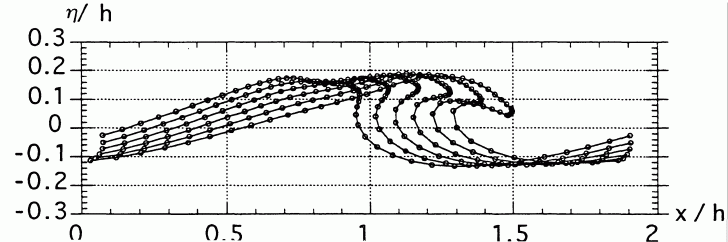
The change in wave height as the waves move into shoaling water and breaks depends on the ratio of the of the slope of the wave face of the deep water waves to the slope of the ocean bottom, but normally lies within the range of 0.78 to 1.2 (Van Dorn). As an approximation, let’s assume a ratio of 1. Now let’s see how much a doubling the wave height (H) will increase the wave speed:
Vwave1 = sq-root (g x (H +(3/4) x H) = sq-root ((7/4) x H)
Vwave2 = sq-root (g x (2H + (3/4) x (2H)) = sq-root ((7/2) x H)
So the ratio is:
Vwave2 / Vwave1 = sq-root (2)
…hence doubling the wave size can be expected to roughly increase the surfer’s speed by roughly 40%.
Now let’s estimate what change in speed will occur by doubling the slope of the wave face at the position of the surfer.
The steady-state speed is achieved when the thrust generated by the combination of the sloping face of the wave and gravity (via the weight of the surfer and board) is equal to the drag. For a 1st-order approximation, we assume that the surfboard is moving sufficiently fast that the primary source of drag is from skin friction, In that case, the drag will be proportional to the square of the speed. We also note that the force associated with the sloping sea surface is linearly proportional to the slope of the wave face. So doubling the slope of the wave approximately doubles the thrust associated with gravity. The system responds by increasing the speed of the surfer so as to double the associated drag. Since drag increases as the square of the surfer’s speed, increasing the speed of the surfer by a factor = sq-root (2) will double the drag and thus offset the doubling of the thrust associated with gravity and the sloping wave face.
So the end result is that the two factors are roughly equal – and to get a better estimate, one must go to a higher order of approximation (which greatly complicates the analysis).
There are many difficulties in computing an estimate of the speed of a board. Not the least of these is that changes in any one factor affects the magnitudes of many other factors. By way of an example, increasing the angle-of-attack of the board relative to the face of the wave not only changes the lift generated, but also the induced drag. Moreover, the altered lift and drag change the wetted area of the board. The change in wetted area changes the aspect ratio of the wetted surface, thus changing the lift coefficient for the bottom of the board. The change in lift coefficient changes the lift generated by the board, which in turn changes the aspect ratio, …etc. And so it goes. Only nature has an easy time in accounting for all these changes.
The situation is much simpler for a hydrofoil board with fully submerged foils since the wetted area (and aspect ratio) is normally constant. For the interested reader, I’ve attached a MS Word file that contains an outline of a procedure to determine the steady-state speed of a hydrofoil-based board utilizing fully submerged foil(s) to illustrate the representations of the various forces involved in solving this simpler case. Unlike the surfboard model (which requires a computer to execute the simulations) this model can be (and has been) executed using a spread-sheet. Although less representative of surfboard hydrodynamics, it still can provide some insight as to the relative importance of various processes.
UPDATE: I was unable to attach the MS Word file as it exceeds the file size limit by about 20% (and I don’t have the time to rewrite it). Sorry!