Bottom Loading in Surfboard Design

Seems like “bottom loading” should be an important factor for surfboard design, especially since surfboards are “planing hulls.”

bottom loading = displacement mass divided by the planing surface area

Should be possible to determine a general, desired bottom surface area range for any given rider’s individual weight.

Planing speed is significantly affected by displacement mass (load) and planing hull surface area.

Did some searching and found a general recommendation (no substantiating source offered);

“Generally accepted guideline for a planing hull that planes easily is a bottom load of no more than 50 lb/ft^2.” (?)

(Bottom surface area and wetted surface area are different. But for a surfboard there should be a reasonably constant proportion dependent on bottom surface area and rider weight.)

Found these too;

“In general, lower is better, within reason. A boat whose bottom loading is much less than her competitors’ will be quicker to pop onto plane and better at low to moderate speeds, but may have a bouncy ride in rough weather.

Less than 100 kg/m2 (20 lb/ft2) - This implies a very light hull that should pop up on plane quickly at low speeds.

About 200 kg/m2 (40 lb/ft2)- For boats in the 4 to 7 metre range, this is the point where getting up on plane needs a bit of effort, and there may be a range of “no-go” speeds where the boat plows around with its bow in the air. Once up, planing can be easily sustained.

About 300 kg/m2 (60 lb/ft2)- For a boat in the 4 to 7 metre range, overloading is indicated, and the boat probably won’t plane very well. Given enough power, it may run OK at high speed, but will be a dog from 8 to 20 knots or so. In boats from 10 to 15 m LOA, bottom loadings in this range are typical and indicate reasonable performance.

About 400 kg/m2 (80 lb/ft2)- Bottom loadings in this range on a 5 to 10 m boat indicate almost no ability to plane. On a 10 to 15 m boat, this bottom loading would indicate slight overloading and poor low-to-moderate speed performance, and on a 20 m boat would imply typical, but unremarkable, planing performance.”


As a planing hull boat increases speed, hydrodynamic forces allow it to rise up, reducing the amount of hull in contact with the water. This decreased wetted surface area results in less drag, making it possible for the boat to travel faster.

The transition to planing typically occurs around 15-16 MPH, depending on the design and load of the watercraft.
1 Like

Some more general information about planing speed for planing hulls;

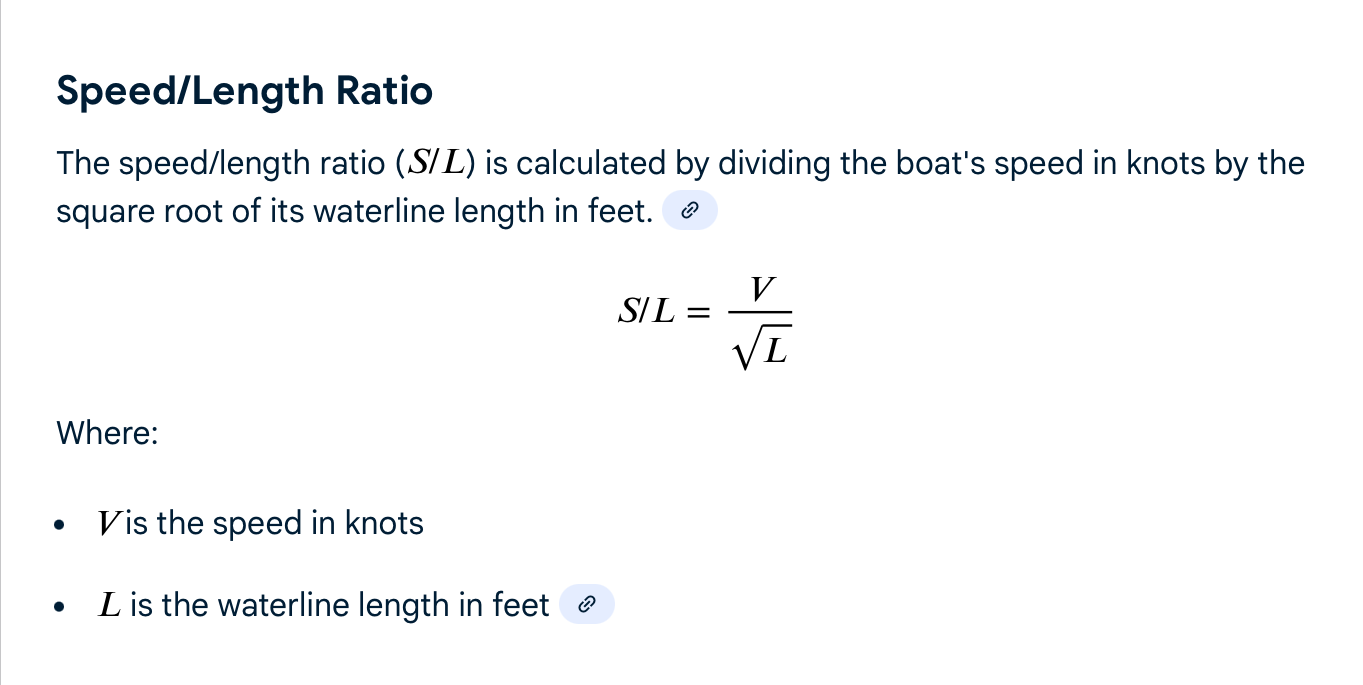
The Speed/Length ratio is a measurement used in naval architecture to compare the speed of different boats regardless of their size.

  • Displacement hulls push water out of the way creating a bow wave that limits speed.
  • “Planing hulls are designed to rise up and skim on top of the water’s surface to overcome bow wave resistance.”

“A boat with a displacement hull is limited by its “hull speed,” which typically corresponds to an S/L ratio of about 1.34. A planing hull is designed to overcome this limitation by generating hydrodynamic lift as it increases speed, causing it to rise out of the water and “plane” across/over the surface. This reduces the hull’s drag and allows it to achieve much higher speeds for its length. The range of 2.5 to 3.0 represents the point where the boat has fully overcome the wave drag and is efficiently skimming on the water.”


Interesting information but it does not factor in the effect of “displacement load” on the planing speed of planing hulls.


Also Lindsey Lord’s work with planing hulls clearly shows aspect ratio affects the wetted surface and load capacity.

1 Like

As a slalom windsurfer, a small boat that go mostly straight over flat water, i should take care of planning hull theory when i engineering my boards. Not so much for surfboards that mostly, fall and rebound to turn on a curvy wave, not exactly field of planning hull theory for me.

IMO planing speed is important for surfboards for take-offs, maximum speed, down the line surfing (especially deep in the curl) and for coming off of re-entries.

However, my primary point/interest is that displacement loading (lb/ft^2) affects planing speed and acceleration — affecting time and power required to achieve critical velocities (planing, take-off speeds, etc). Displacement loading would also affect paddling speed.

Seems like it would be possible/desirable to calculate preferred surfcraft bottom surface areas for individual rider weights.

I sailboarded for a few years on inland lakes.
Sailboards allow you to change displacement load depending on wind speed and sail (wing foil) lift.

I didn’t use foot straps. I liked to walk the deck while riding. That is how I got higher performance out of a recreational sailboard. I didn’t like using a boom harness either.

When wind speeds were high, sail thrust and lift were high. I could plant at least one foot on the rail and lean back (out over the water) — hanging from the sail. The sail was then supporting (lifting) a significant portion my weight. This reduced the amount of my weight (displacement load) placed on top of the board, which in turn increased my speed. This is another way displacement load can be different for sail boards — it is variable depending on wind speed, sail (wing) lift and body-lean/sail mast angle.

So a 8’4" by 24" board (imagine it’s flat and square for ease) is ~16.67 sqft. So 20lbs x 16.67 is 334lbs.

Just a cursory glance at those numbers tells me that perhaps there’s not a 1:1 relationship of boat bottom loading and surfboard bottom loading.

I’m 1.95m and 115kgs and I like riding boards in the 8’4"x23.5x3.5 range (65-70l). There’s no way a 334lbs person can ride my boards in typical east coast USA surf conditions. Sure maybe in 4ft and 16+ seconds period swell… but in those conditions were headed towards barefoot skiing physics.

As I stated those values are “general” with no real substantiation — intended to communicate the concept of bottom loading. I will assume there is a power factor involved (hp). Perhaps a differing size relationship for smaller surface areas too.

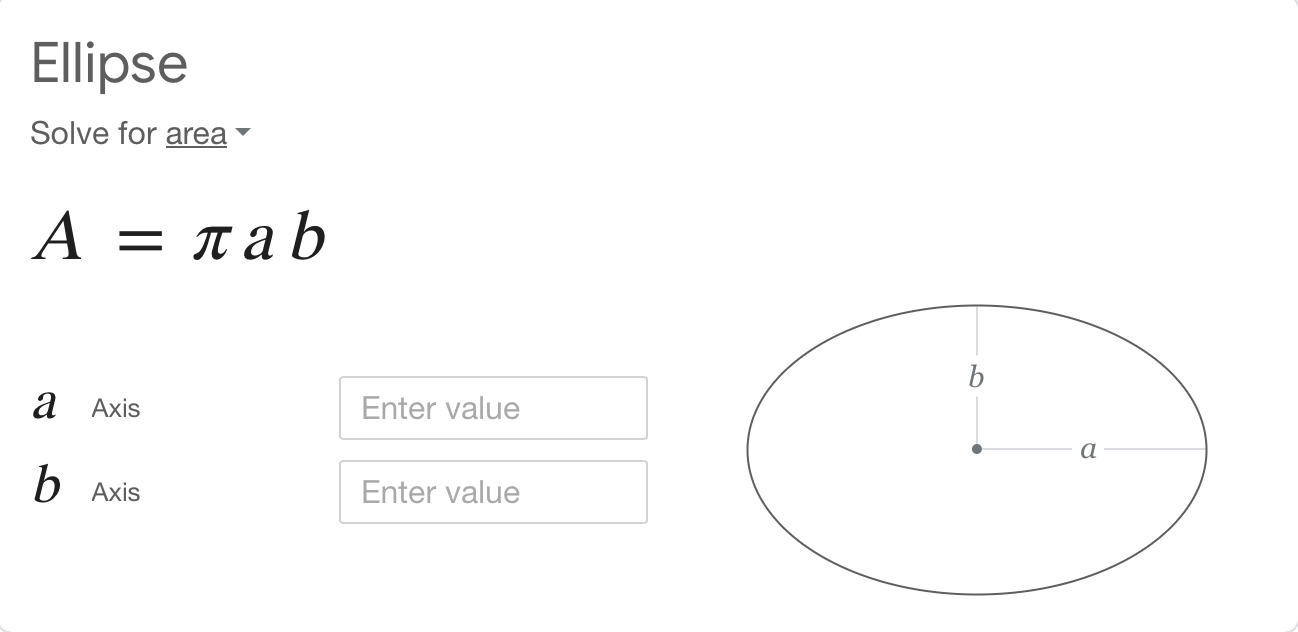
Assuming a board with the same dimensions as yours is elliptical, I come up with a bottom surface area of 1,845.7 in^2. Divided by 144 in^2, I get 12.8 ft^2. Multiply by 20 and I get 256.3 lb.

Then, what is the planing speed required relative to wave speed? How much power is required to achieve that planing speed. What is critical take-off velocity. Static drag and inertia for that load? Acceleration and time needed to achieve planing speed?

Many unkowns. But I am confident there is fairly reliable ratio of weight to bottom surface area for rider:SB that would useful.

I’m sure you could come up with a rough bottom loading relationship using board isize recommendations for rider sizes from somewhere like FireWire. Doubt they would be science based though.

2 Likes

With a wetsuit on, I’m going to reasonably assume you weigh more than 115 kg (253 lb).

1 Like

That is assumption I can factually verify. LOL.

2 Likes

Windsurfing with harness and footstraps on a planing machine is an other sport. Without harness you can’t use powerfull sails, with straps you can go far faster in chop. I make me a windsup, use it a lot strapless, since i add straps i can use my big powerfull racing sail in stronger wind, double my top speed.

1 Like

From my hydrofoil designs I found that a submerged surface of just 230 sq cms is enough to lift 85 kgs of man candy out of the water. It’s the size of a Large dinner plate.
That doesn’t seem like much area but it’s directly in contact with the wave on both sides of the hydrofoil plate, whereas a HPSB is in contact on just one side.
Food for thought…

Interesting point Brett.
But I will assume required planing speed for your hydrofoils is not the desired planing speed for ease of paddling and catching waves.
And bottom loading is determined for the surface area of the planing hull, presumably prior to planing.
Also, I will assume required wetted surface area for easy planing is proportional to total bottom surface area.

Surfboard Bottom Loading Estimates

I remembered Harbour makes surfboard size (length, width, thickness) recommendations based on rider weight. They make those recommendations for longboards and mid-lengths but not short boards. I chose one representative shape from each category.
I picked board shapes that were closest to elliptical.
For the longboard, I chose the Rapier and the mid-length the Spherical Revolver.

I calculated bottom surface area from length and width data for each board, using the surface area equation for ellipses. If there was a weight range, I picked the weight in the middle of that range. I used the data for the shortest and the longest board for each shape to calculate a bottom loading range for each board.

Since Harbour has made over 34,000 surfboards since 1959. I will assume they have a reasonable grasp of what size surfboard works well for a given rider’s weight. This should provide a credible approximation of bottom loading values for longboard and mid-length surfboards.
(I will assume bottom loading for longboards is for ease of paddling and wave catching.)

Spherical Revolver: mid-length
Rider weight (lb), length, width

140, 6-10, 21.5”
Bottom Loading (lb/ft^2) = 14.6

210, 8-0, 22.5”
Bottom Loading (lb/ft^2) = 17.8

Rapier: longboard

125, 8-6, 22.25”
Bottom Loading (lb/ft^2) = 10.1

240, 10-6, 23.75”
Bottom Loading (lb/ft^2) = 14.7

1 Like

I probably don’t understand what you speak about.
No way a surfboard plane when paddling, those boards sized guide are based on flotabilty volume.

Hi Lemat, I would think a longboard planes clearly when paddling, not planing entirely but to a degree it rises ?
Bill, correct the planing speeds for board or foil are not the same , but interestingly
( or not), lift quadruples on a foil when speed doubles and is limited by the wave itself. So if you were riding Pipeline it would probably take a very small foil , like a butter plate size to lift a hairy gent above the surface.
When you drop in with a foil it goes from paddling speed to top speed in 1-2 seconds.

1 Like

Lemat,

First and foremost, increasing load increases inertia.

My take is that planing speed is directly related to surface area, power, aspect ratio and load. If your bottom surface area is held constant, as you increase load, the speed required to plane increases.

You can water ski easily with 2 skis at 25 mph. A single ski requires higher speeds to plane. To barefoot water ski, you need very high speeds. Rider weight (load) doesn’t change — but bottom surface area does. Volume/buoyancy is not really a significant factor.

For surfboards, volume changes submerged surface area (float, buoyancy) — depending on load, static/form drag increases in particular. It also affects ease of balancing especially when combined with proper width.

For the bottom loading I calculated, the trend is, as bottom surface area increases, load capacity increases, for both mid-length and longboard SBs. However, there is an optimum range for load/surface area.

If you hold thickness constant, volume has to increase as bottom surface area increases. However, as length increases for a fixed thickness, flex increases; changing performance. If flex/stiffness was constant — regardless of thickness — planing speed would change as surface area increases if aspect ratio is held constant.

Bottom line, changing bottom surface area changes planing speed for a fixed load — volume not so much.

The largest change affecting bottom surface area (and volume) comes from increasing length. While volume correlates, it does not necessarily imply cause. It is surface area that most significantly affects planing speed.

Aside:
Back in the dark ages, when I was 160 lb of twisted steel and dynamite with limitless energy and power, it sure felt like my 9-8 Bing was planing (gliding effortlessly) while paddling relative to my 5-6 Hansen twin fin. BTW the 5-6 Hansen was hollow and thick with lots of buoyancy.

Just my $0.02

There’s a similar way to arrive at this idea of the importance of surface/planing area that I think works to bolster the bottom loading hypothesis using known qualities (solid surfers and what they ride).

Devon Howard, ~86kg, rides a 6’10" by 21" CI M23 (43.4l)

If we take the square root (2D measurement) of my weight over Devons
115/86 = square root of 1.34, so 1.18. Now I have a multiplier I can use against the length and width to resize a board that works under a solid surfer, Devon.

Length 82" * 1.18 = 96.76" or ~8’1"
Width 21" * 1.18 = 24.78"

Now if we look at volume (3D measurement) of my weight over Devons
115/86 = cube root of 1.34, so 1.05

43.4 L * 1.05 = 45.57 L

As it happens I own the largest stock DIMs of the M23s they make at 8’ by 22.75" (62.5l)

So my M23 acording to the modeling is slightly too short, much too narrow with a lot of extra volume. All of those differences are noticeable in the real world. It doesn’t get up to plane as rapidly, it’s an effort. It is too easy to bury a rail. It does paddle very well for a smaller board. I would love to try an 8’1" 24.75" M23 with similar volume.

All this to say I think there’s merit in the whole bottom loading/surface area/planing surface as a critical measurement and it appears to track with volume sizing charts and real world experience.

PS- I can’t stand the weight gaps in Harbour’s charts… I like Rusty’s even though it stops at 240. :frowning: Volume Calculator | Rusty Surfboards

I will add a Google AI summary for a little more perspective.

”Bottom surface area has a significant, but complex, effect on the planing speed of a boat.

Planing occurs when a boat reaches a speed where it is lifted by the dynamic pressure of the water on its hull, rather than displacing it. The relationship between bottom area and speed is governed by the concept of “bottom loading,” which is the boat’s weight divided by the projected planing area.

Effect on reaching planing speed

For getting a boat “on plane” at a lower speed, a larger planing bottom surface area is more efficient. This is because a larger surface can generate the necessary lift at lower velocities.

  • Low bottom loading: A boat with a large bottom area relative to its weight (low bottom loading) can reach planing speed more easily with less power.
  • High bottom loading: If the bottom area is too small relative to the boat’s weight (high bottom loading), the boat may struggle to get on plane or have poor overall performance.

Effect at high planing speed

At very high speeds, the effect of the bottom surface area changes, and a larger area can sometimes become a detriment. As speed increases, the dynamic lift becomes so strong that less and less of the hull’s bottom is needed to support the boat’s weight.

  • Reduced wetted area: The bow rises and the boat “runs” on a smaller, aft portion of the hull. The forward boundary of the wetted area moves backward as speed increases.
  • Potential instability: For some high-performance hulls, such as those with a pad bottom (a narrow, flat section down the keel), a smaller running surface at high speed can lead to instability. This is because the boat is riding on a narrow flat surface.
  • Drag: In some cases, a larger bottom area can mean a larger wetted surface area. While less critical when fully planing, a larger overall wetted surface can lead to higher drag from skin friction, which is a major factor at high speeds.

Design considerations

Boat designers balance the bottom surface area to achieve the best performance across a range of speeds.

  • Low-speed planing: A boat designed for easy, low-speed planing will have a relatively large bottom surface area for its weight.
  • High-speed racing: Hulls designed for very high speed, like certain racing boats, may use a smaller, flatter surface like a “pad bottom” that provides extra lift but can become less stable at high speeds.
  • Overall performance: Designers use tools like spray strips and vary the deadrise angle to optimize lift, drag, and stability at different speeds.”

Knowing surfboard volume is useful. That measurement makes it possible to evaluate/calculate buoyancy (“float”) for individual rider weights. But it is only an indirect indicator of bottom surface area.
IMO without listing corresponding bottom surface area, volume data has limited application.

The same software that calculates volume should be able to generate surfboard bottom surface areas easily.

Knowing bottom surface area would make it possible to evaluate bottom loading (lb/ft^2) for an individual rider’s weight. IMO that information would make surfboard size selection/evaluation across different shapes more accurate — also providing more insight about planing speed and ease of paddling. It should also be useful for looking at performance related to shapes when both have the same width and length (aspect ratios).

1 Like

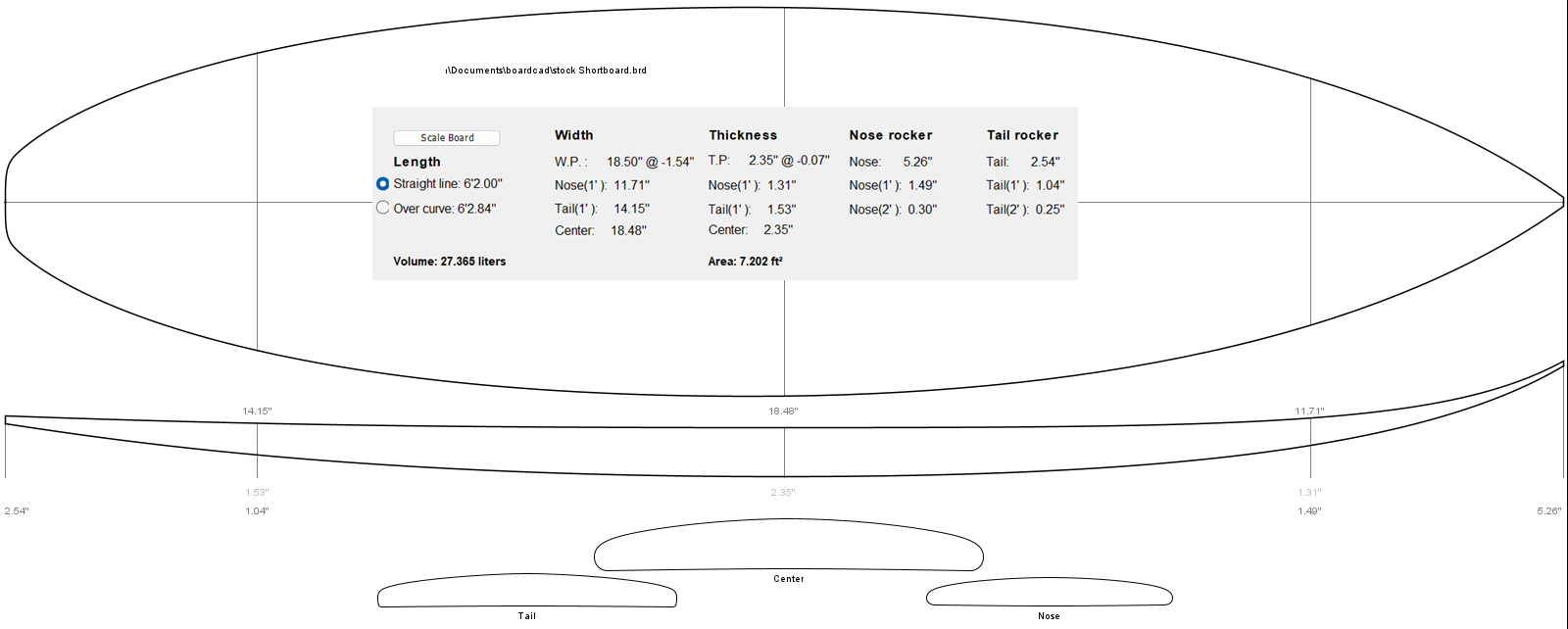
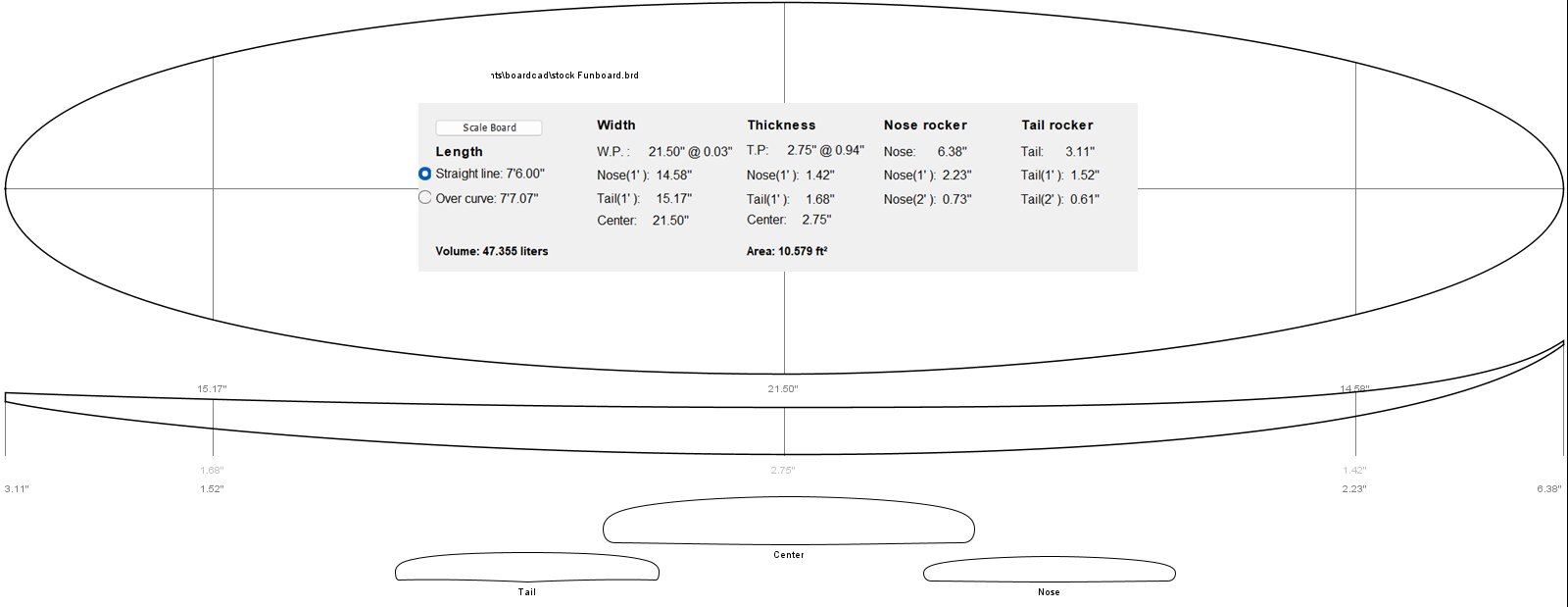
Boardcad LE presents a plan shape area number, Akushaper and Shape3DX do not, at least in the free versions that I have.

Here are three examples, the stock boards from BoardCAD LE:


The bottom surface loading idea is interesting…but how does one account for what happens on a wave? Nose up and out of the water, one rail lower than the other, tail engaged… would not the effective bottom loading be greater, more weight per square area, that the simple calculation based on rider weight divided by planshape area ? Even nose rocker at rest would be a slight deduction from available surface area.

Just musing, no bones to pick or theories to prove…

A surfer and board at rest, a surfer and board in a wave, a website with more surf pictures:


https://unsplash.com/s/photos/surf

4 Likes