I finished shaping and glassing my first board earlier this month. its an 8-0 2+1 egg shape. It was a great experience and now im kinda hooked on it. But it doesnt surf that great as it was a learn as you go type project. I learned what to do, but more importantly, what i think i shouldnt do. For my second build i want to have everything planned out first. Im posting the specs with a profile of the foil and rocker. For reference, i am 40, 220 lbs, 5’11” and this will mainly be for waist to head high steep-ish central california beach breaks. My hope is that its will be something that can get me into waves early, but be able to take steeper drops than what im comfortable with on my longboard. not super performance oriented, but quick enough to get past sections and do some carving. I am happy to take and consider any and all advice given to me by the community that knows way more about this than i do.
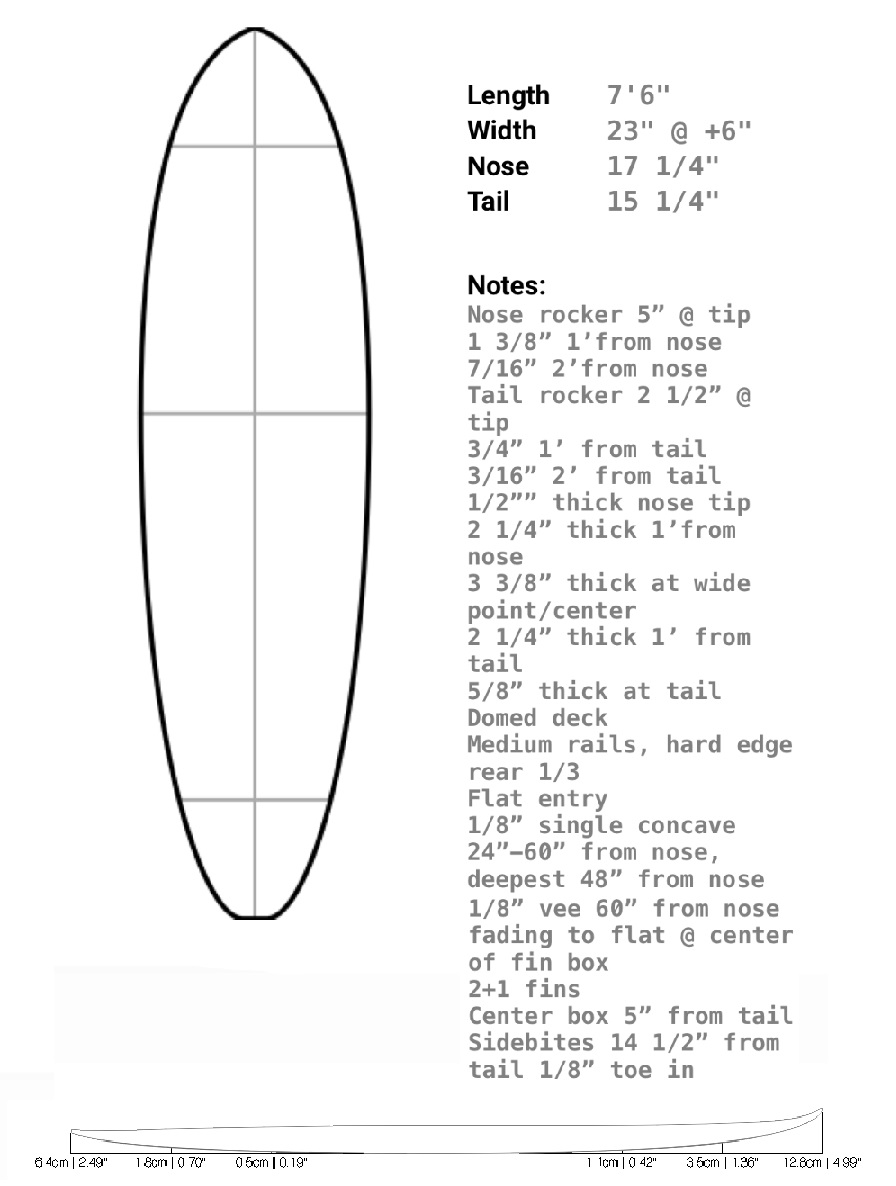
There is a lot variation in beach breaks on the Central Coast of California. From steep and fast to slow and easy. From Jalama to Pismo and on up to Morro Bay and beyond. The thickness, width and overall rocker may be wrong for the type of wave you describe. I reread your post this AM and edited my reply when I realized you stated the type of wave it was for. I would say; Not enough “overall rocker”. Too thick and to wide for the type of wave you described.
thanks, i appreciate the feedback. a-beach/morro strand is the usual spot, but it will be used all over from pismo to cayucos. too thick and wide, even for my weight? and what would you suggest for the rocker? more nose and tail kick, or more curve with less of a flat spot in the middle? or a combination of both?
Less of a flat spot in the middle. As an old guy who haunted and hunted the Central Coast for years the advantage to an inch or two less width and 3/8” thinner will make for a quicker take off and better positioning. I’m over 200# myself, so I understand what you are saying. Take what I am saying with a grain of salt. Try it the width and thickness that You have, but get rid of the flat rocker in the middle. Don’t go overboard, but try to choose a blank that has at least a little overall rocker. If I were you I would shape myself a 9’0” and ride it like it was shorter. The fastest easy paddler I ever rode on the Central Coast was a 9’0 Stewart Hydro Hull. I could stuff that board in any tubey section from the SM Rivermouth to Old Creek. 3” thick, 23 wide. Turn on a dime, catch any wave.
Coincidence: I’ve just returned to the Central Coast and I read your post right after finishing the template for a board very close to what you’re designing, with the same motivation – board dimensions 7’6” twin egg, 17—22—14½, 3¼ thick; my own dimensions 6’1”, 200lbs, 54yr, and I’ve been mostly landlocked for the past 15 years so I need some extra help getting into the waves, especially for the brief glorious barrels of these Central Coast garage door closeouts.
This will be the 4th board I’ve shaped this year [8th overall], and it was only with the last one that I really got it right, smaller but faster than the previous two, and now I’m trying to understand why it works so much better—this has led me down the Swaylocks rabbit-hole of learning about rocker…
I just picked up a US Blanks 7’10”SP, the rocker is already pretty close to what I want, but I’m still fiddling with the numbers (definitely don’t want any flat spots for these steep waves, I’ve made that mistake before)
PM me and we can collaborate
I just visited the central coast for my first time in October. Drove SanFran to Santa Cruz. Probably the best day trip I’ve ever done. I only surfed Pacifica and Cowells. Next time I’ll take more time and definitely try some of the state parks in between.
Could you rentor borrow a couple boards of varying thickness and rocker to give you a better idea of what you are looking for?
An Arctic 7’9”SBF is what you want. Makes a great 7’6”. The Arctic 7’3”SBF is a shorter version of the same thing and makes a nice 7’2”. For the type of board you guys are talking about these two blanks are the best available. The overall rocker is perfect for the conditions on the Central Coast and both have necessary thickness for a bigger guy. Go to Arctics website and check it out. You will see what I am talking about right away. No guesswork with these two
Thanks for all the advice, especially as you have the local knowledge. Im trying to rework it now. As far as the blank, my local supplier does is blanks so was thinking a 78a. Im not opposed to the arctic at all though if they can get me one. Particularly if its the polyola version, since im kind of a tree hugger like that. Im not sure how much different trying to shape eps than poly is though. As far as the longboard, its definitely something i want to do in the future.
I not on the CC of California any more and I am not trying to sell you a blank. But purely by coincidence I sold a 7’9”SBF with a black stringer last night. I haven’t looked at the U.S. Blanks catalog in awhile, but if my memory serves me right; The A series blanks were always good blanks. Even the 7’0”A that Clark did was one of Clark’s best blanks. I don’t sell US Blanks up here in Oregon because Jeff and Therese(sp). decided that I was too close to Fiberglass Supply up in Washington. (4 or 5 hours north of me). I had an account that was set up in advance, approved by one of their managers back when they first opened their doors. When I went to place an order, they canceled me. Classic Clark tactics. I don’t know how many(hundreds at least) of Arctic,Marko and Millennium I have sold up here since. Even when Shapers Supply moved up here and brought his Arctic dealer title with him, it didn’t make a dent in my sales. I’d have to call Tillamook PUD and find out when I first had power turned on. But I have been in the same junkyard looking shop doing the same thing since about 2010.
since the brief exchange of this thread, I thought I’d share a little update (long post) on my project, with a question/mystery about rocker and contour at the end
I used the 7’10”SP for the template I took from Blending Curves, their 7’6” Egg C, deliberately stretched out to 7’7”, accidentally shaped ¼” or so narrower than expected
Day 1: worked from raw blank to mostly finished shape, 16½ x 22 x 14¼, 3¼ thick, very full foil (lots of foam up front)
Day 2: cleaned up details on the rails, finished sanding, installed twin future fin boxes @11” from the tail (1/8” toe)– glassed the bottom with UV cure resin, glassed the deck but lifted the garage door to discover the sun was just setting! left the resin-soggy board in the garage overnight
Day 3: resin/cloth still uncured, lots of delam bubbles from sitting overnight! sliced bubbles with a razor, smeared new resin in the cuts, mashed it down, brought it out in sunlight to cure; turned out okay. Hotcoat top and bottom, sanding, done
Day 4: I know I should have let the board cure a few more days at least, but I was too stoked. I put in some Future K2 keels fins and took it out at Morro Rock, 2-3ft and kind of weak swell. As soon as I hit the water I was amazed at how well it paddled; I can get up close to the nose to paddle into waves super early—and I’m still able to duck-dive easily.
easily caught the first wave I paddled for, but was afraid I’d made the rails too soft… however, every other wave after that convinced me I’d gotten it just right. I had so much fun! It’s a wave catching machine! generates speed with a longboard-like side-slipping motion… however, it still felt a little bit stiff, and maybe needed a bit better hold, so…
Day 5: similar 2-3ft weak swell at Old Creek; I switched out the Future K2 keels for the more upright Britt Merrick Twin fins and OMG suddenly I was carving all over those poor little waves—I’d been afraid that I left too much foam up in the nose, but I actually got that board vertical easily, hit the lip and swung it around to land smoothly—and when the face starts getting steep the board takes off! so much fun, I didn’t think it could get any better, but…
Day 6: same 2-3ft swell at Old Creek, but the inside had a bit more punch. I switched out the Britt Merrick Twin fins for my new 520 S-Wing fins (I’ve only tried them once before, picked them up just before I left France a couple weeks ago)—the only way I can describe what happened with those weird fins on this new board was like the kind of cliché scene from Sci-Fi movies where a hotshot pilot hero gets to take control of an alien spacecraft, then goes totally wild with its far-out capabilities—insanely fun! super loose, but with TWICE the drive, I was making sections I never would have attempted before… flying all over the place, catching everything, floating sections, sweeping cutbacks with a boost of acceleration right at the apex of that turn, discovered some kind of tail-shove driving technique that plays with the flex of those S-Wing fins—so much crazy fun—after many years living landlocked and going soft, I was exploding with stoke
[a few days went by]
today: bigger 4-6ft swell at Morro Rock, using the Britt Merrick fins again, got to test this board in some head-high drops and was amazed at how easy it was to catch and get in early (rode one wave a long ways before it even started to break farther on the inside)—got a few really long lefts, some fast sections, some sweeping cutbacks, a couple speeding floaters, and OMG this board glides like silk…
needless to say, I’m quite pleased with how this board turned out, but I’m still too much of a novice to fully understand my successes – when I compare the successes of this board and my last one with the failures of the previous two boards I shaped this year, it seems the main difference has been the continuous rocker with no bottom contours. There are certainly many other factors that I don’t yet comprehend, but at least for the moment it seems I’ve gained a lot of speed and swooping-curving-turning power in both mushy and punchy waves
this seems to be contrary to the usual advice that would attribute speed/paddling power to staged rocker and concaves—though I’ve also read some suggestions in these pages (Stoneburner?) that contours can actually create drag…? again, I’m a novice, so I’m unaware of many contributing factors, but the 2 boards I shaped with concave in the middle and vee out the tail seemed to have the breaks on… can someone offer insights on this?
Overall rocker and necessary thickness.
The greater the tail Vee the slower the board (loss of tail lift).
Spiral Vee creates drag (delta-shaped Vee).
Rocker (tail Coanda Effect and nose plowing) and concave can affect speed.
Rail shape affects Coanda Effect.
Center of volume mass affects center of buoyancy.
…