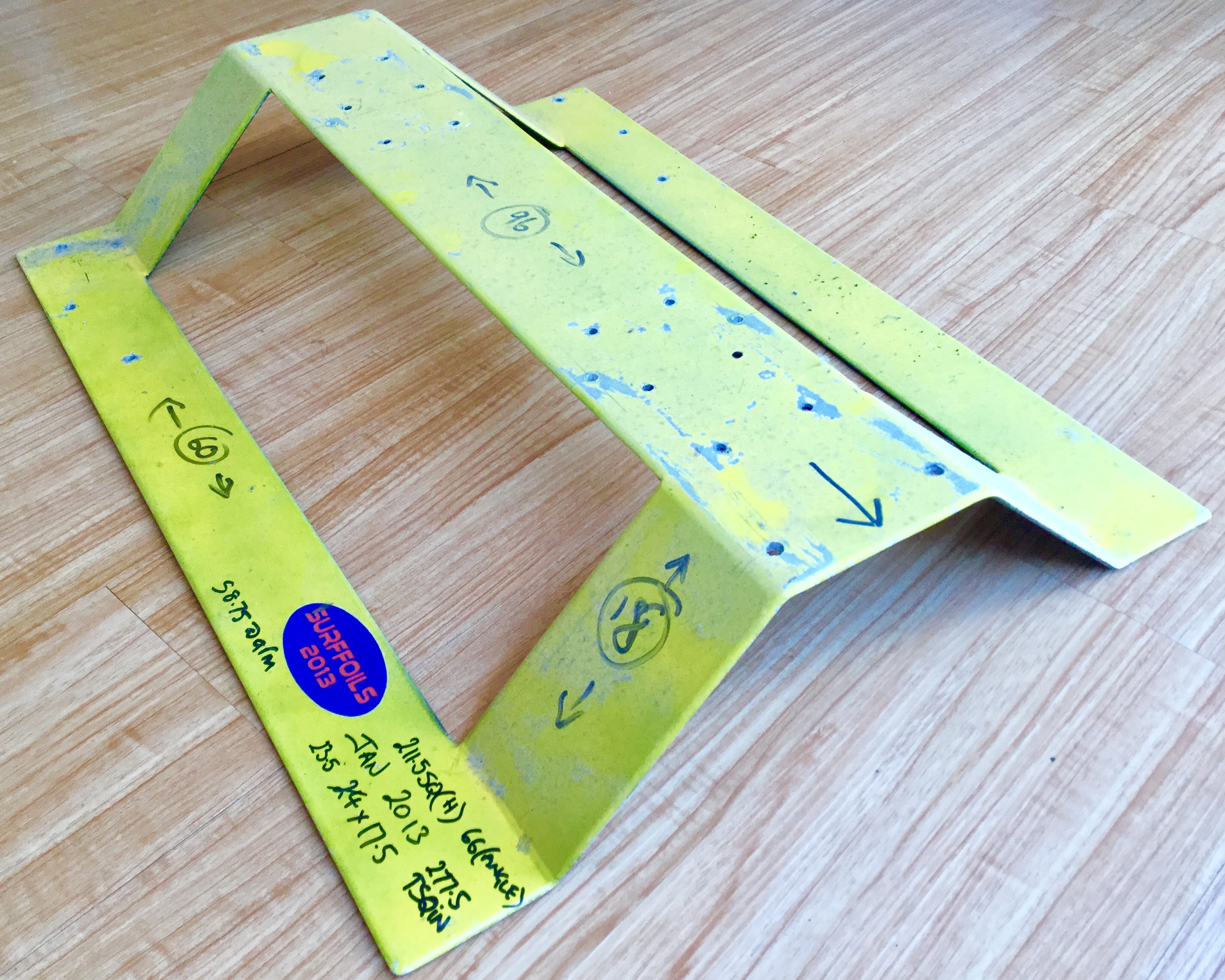
Yes it’s great that all the dims make for a much safer foil, no slicing your hands when paddling and it keeps the foil from ventilating.
26 inch foil length should be plenty stable for anyone.
I’ve done hundreds of ply foils and I use anything under 10 mm thick, both the foils in the pics here are 4mm, the bullets got CF on one side and 4 oz on the other . Way over engineered !
The donut foil is 4 mm 3 ply with only epoxy resin to waterproof it. No glass at all. And I use the cheapest ply I can find.
So hopefully the Board was free and making the Foil should cost nothing or very little.
1/2" is a bit too thick/ heavy. Id keep it as light as possible because then the foil doesn’t resist when you’re riding.
In a perfect world I’d go for a vacced 4 mm XPS foil with CF on both sides.
In the real world, 3 ply is just as good.
Thanks for that Gdaddy !
The opportunity here is for everyone to draw their own, use your imagination to work on a foil design.
No one told me about long foils, tapered template or the fenestrated foil designs, Im fairly sure I invented them all.
But anyone here could come up with something even better if you give it a try.
Will I need a stringer or are we going dual struts w/ sandwiched plates? I have a stringerless wide, flat 5’6 mini simmons that seems perfect for a foil board.
Template question: wider in the front or back? I saw that you said wider up front is easier, but your template you made was wider in the rear.
So stoked for your help and to build one. My 8-yr-old wants to make a prop-powered one. I think making a regular arm-powered one is a good starting point to jump off from.
If we’re using multiple struts then I’m wondering if I can’t just get away with using longboard style channel boxes and building the struts like a fin. Maybe rout in a couple of longer mini-stringers on either side of the box to stabilize it so the torque doesn’t rip them out under load. That would eliminate any excess drag on the hull itself. Get a little fore/aft adjustability in the process.
No stringer needed but interesting point about riding a foil with the wider end forward or back.
It’s going to be a matter of personal preference but I think it’s connected to the ’ front foot/ back foot’ surfer style. Some people prefer the width at the back but I routine.ly spin the foil around and it’s a similar performance but you have to change your weight distribution… if you move most of the area forward, you don’t get much with a strong back foot… I prefer the width at the back.
Gdaddy, I left the mast/ struts conversation for last as it’s more complex. Just like the foil design, I’ll offer up what I know and you can do it however you choose.
What foil does the foil have?
How come it lifts the board and rider up, rather than pulling them down into the water?
I’m just trying to understand what creates the lift force towards the water surface.
Is it just a flat foil and the AOA is controlled by the surfer so that it created upward lift, or does it create upward lift at any (or most) angles?
This is my favorite discussion here in years! @MrMik, the foils surffoils has shown here all look flat.
The edges are more rounded than sharp as you can see from how the wood plies run.
Since the foils are thin, and have some struts forward and some aft, they will bow upwards when ridden, creating a camber/foil between supports to give lift. The lift made this way is especially effective at low (paddle-in) speed. Positive angle is still required for lift. This is a cool approach to the problem, with out a lot of carbon or a heavy, very thick wing (found in expensive commercial foils like aguera or takuma etc)!
MrMik and bwd, we’ve all experienced the rising water up a wave face and it’s a much gentler effect further away from the breaking section. Further away is where the other foils are king, they use a highly effective foil cross-section to get great lift further away from the break. Closer to the break that effective foil section becomes unstable because there’s too much lift.
Closer to the break there’s tons of lift and you don’t need to encourage it so a simple flat foil works very well. It’s just AOA regulating the massive lift just under the wave face.
On a simple flat foil you won’t be able to charge 50 metres away from the break but you will be able to surf in the same zone that you usually do. Drop in, pull in, tube, spat out silently onto the shoulder at warp speed, cutty and repeat. The silence and smoothness is surreal and you can pull off one wave and link into the one behind or one in front.
The other foils and mine perform at different ends of the spectrum of wave energy. It’s definitely possible to take a foil design like mine, add some foiling similar to theirs, and create a foil that covers a wider range of conditions.
Bwd, you’re right about the edges, you’re not making a samurai sword so just rounding all the edges is enough for good performance without creating a safety issue. Bringing the foil width in from 23 inches to 16 or 13 inches also halves the danger of slashing someone or yourself. The thinner foil does flex to create camber and it does add to the overall lift. All the forces are up, pushing the foil towards the board creating drag that lifts the foil and with such thin foils there’s little form drag slowing the foils acceleration.
I didn’t think anyone would understand foiling physics, but it seems many of you understand how it works far too well !!
We’re not just users here on Sways - we also build and tinker. That’s why I think it makes sense to work a progression starts with “gliding” before we move on to carving and pivoting. I want to (eventually) understand what I’m doing and why it works and what the effects are of changing the different variables.
I’m dead serious about eventually getting to a board and foil combo that will operate out where the 11+ft gliders function - and away from the active surf zone - but in a more controllable length and with less hazard to bystanders as I do transit the shorebreak on my way in and out. I already use a 10" flex fin on my singles so as far as shipping and handling at the shorebreak I reckon I can already deal with that depth of underhang without a problem.
You should be able to alter lift properties of a flat foil by shifting the leading edge curve of the foil, for example, 50:50 to 45:55, 40:60, 30:70 (top:bottom)…
Aha, it’s that force in the water that snaps off fins when they are not strong enough.
I think I would build a strong thin core for the foil and 3D print exchangeable foiled additions for experimentation and later (once known what works when) for adapting the foil to different conditions on the day.
Do you think 2mm holes in a flat foil would cause any issues?
Maybe SS nuts could be in-layed from the top, and screws inserted from the bottom to close the holes when they are not in use for attaching 3D printed foil parts.
MiMik, there’s a lot of room for experimentation here to customise foils for certain waves and riders and 3-D printing certainly would make it easy for people to create, share or sell a file.
Some of my foils have 20 x 4 mm holes all over them for testing new mounting struts and they seem to work just fine so I don’t think a few 2mm holes will be a problem.
Greg, yes you can pump the flat foils, the shorter ones are easier, even riding prone you can pull the nose up and down to progress the foil. The Bernoulli foils have a quicker ‘fall and rise value’ so they are more suitable to pumping.
Gdaddy, that’s why Swaylocks is the best place to open this up for discussion and building. Your specific foil is for very gentle waves but if people have their own ideas they can use the information here to make their own. It’s what we do here.
Definitely, for all users, start on a gentle wave and learn a bit about how a foil works before you progress. I remember taking that first wave with 2 sharpened Aluminium foils under me and thinking… shit, this could go very wrong very quickly…
But it didn’t and it’s been a great safe 11 years of foiling. Never had an accident.
The deal with the actual foil is that it’s easy to read how it performs, and then quickly make another, that’s why I’ve got hundreds of the things. And flipping them back to front doubles your options.
Just a point about Foil design in the surf.
Foils are categorised between FS- fully submerged foils and SP- surface piercing foils.
Every foil is going to get near the surface as it lifts.
On flat water a flat foil breaks the surface, ventilates and loses lift so Surface Piercing foils were developed to allow for a certain amount of the foil to rise out of the water and some foil area to remain submerged. So in a flat water environment, a 3-D foil creates an even self regulatory lift.
its the opposite in the surf.
In the surf the wave surface is a 3-D shape like a cone with constant changes on levels across, along and in every direction and it’s possible to use a flat foil to slice through the curves and maintain lift as the wave shape changes. And that’s good design.
The fenestrated foils are not as susceptible to ventilation becuase they mainly rely on Newtonian lift.
But the multi level foils were interesting to ride…
If we’re done with Foils are we ready to discuss the struts/mast ?