Rocker apex

…this is a good visual to offer up. Although somewhat crude, it gets the job done just fine and illlustrates the apex thing (or whatever you wanna call it) perfectly. If you look at that bottom curve as you would an outline curve, then it becomes more and more personal in the total package of what you want to make for yourself or someone asking for certain characteristics in their board.

As stated previously, some guys will take this thinking further, and place the curviest part of their planshape in harmony with their rocker apex.  I would think this would be particularly true of the guys looking for ‘turn on a dime’, pivot carve type performance. That’s esp. true of the “K3” curve depicted here with the “A1” being more conventional but adequate for most surfers wanting a less sensitive turning board.  Guys preferring the “A1” might also site that a full initiated turn (bury the board to the rail) has a rocker curve that feels better to them than the “K3”. The “K3” has what I’ve termed in different threads as an “induced straight”, and the note here that it delivers thrust, is entirely correct.The “K3” has gotta be popular with the ‘get in early’ crowd that are jockeying for wave position at crowded spots.

With the postioning of the peak aka apex, aka deepest part of the bottom rocker curve, the dynamic of each becomes readily apparent to anyone riding these approaches. If you took boards that were identical in every other aspect other than these bottom curves and rode them, they would all feel and surf like very different surfboards.

Would one be better than another? That’s totally subjective and relative to what the rider wants.

The one for Tony Ray, is a forward draft, longer waterline approach that makes total sense for big Sunset or large facey waves whereas a bit more tail rocker curve like the “A1” (but not exactly) might be preferable for a Pipeline type wave. It depends on if the guy ridiing the board wants some release in the tail or is riding it in conjunction with concaves, just as the Tony Ray one might incorporate vee for increased rail rocker and drive.

The bottom line on these is that these lines are highly personal, and how well you can manipulate them to a surfer’s needs is directly relative to how successful you are at delivering a board that someone is ordering from you.

Like I said before, once you start envisioning these “curves as lines in space” (BB), you will become a friend to some, and soul mates to others…

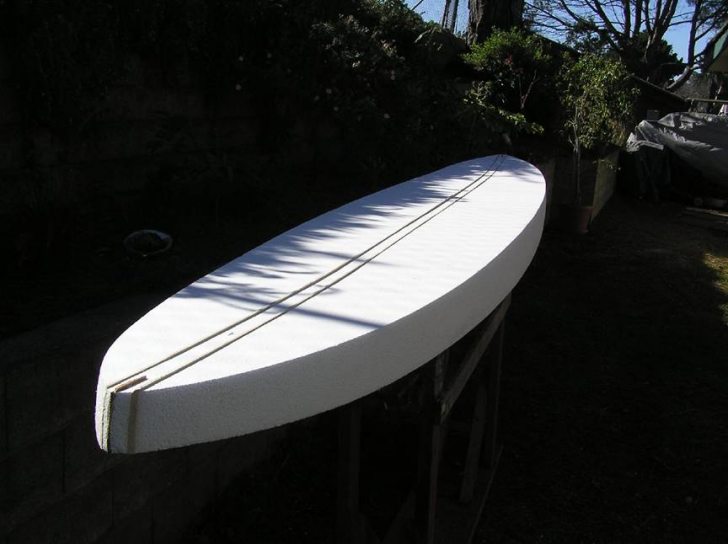
"Isn’t deck rocker just a function of bottom rocker and foil?

You set the bottom rocker, and the deck rocker “materializes” as the foil is distriuted".


…does this look like the deck rocker just “materialized”?

"...........does this look like the deck rocker just "materialized"?"

Yes!  Further more, if you have a specific deck line to which you have your stringers cut and blanks glued, the bottom rocker will ''materialize'' as the thickness in the blank is foiled.  Just as important (IMO) is the way the cross sections ''materialize'' as you foil the rails.

It's really just basic pattern making 101... nothing magic about it.  If you have a basic line drawn and cut out, it can be your baseline as you measure from it.  It really doesn't matter if it is top, bottom, left or right. 

With an outline template, rocker (deck or bottom) template, thickness measurements and rail contour templates, any patternmaker worth his salt should be able to shape a board... even if he has never surfed or even seen a surfboard.


Provided that you have the line to begin with, yes.

What you are looking at is an older styled blank that had major reconstructing of the deck AND bottom to create a specific desired foil.

That’s the difference between the modern close tolerance blanks and some that were around before that movement.

Hi deadshaper -

I'm sure there are some good reasons why the private rocker catalog for Clark Foam ended up being as thick as a phonebook as the blanks became closer tolerance over the years.  I understand that US Blanks also does private rockers... measured from deck or bottom.  No doubt it makes things a hell of a lot easier for anyone doing it by hand vs machine.

http://www.usblanks.com/catalog/about-our-catalog/rocker-selection/

U.S. Blanks has my private rockers as well as a Public Rocker Catalog that I pull from. There’s no additional charge if you pull from the Public Rocker catalog because it is an existing rockerthat someone came up with, they made and have on file, and it was allowed to be made publicly available. 

Private rockers are, exactly that, for private use. 

Obviously looking at the foil I posted, I should have realized no one would know the extent of work went into that final shape. 

The ideal blank I wanted for a close tolerance, quicker shaped order was not scheduled to be poured before delivery time, so they gave me an option which they thought might be suitable. I ‘read the blank’ and gave them the go ahead. 

Reverb mentioned that it isn’t very common on Sway’s to hear people talking about ‘reading the foam’, “de or reconstructing” the blank, or similar experiences because the vast majority of them are hobbyists. Although we know full well there are inustry lurkers too. 

Anyway, your oversimplication kind of shocked me until I was able to wrap my head around it more. I suppose a pattern maker, carpenter or just about anybody can 'make a surfboard"… that’s no doubt why Swaylock’s exists. That, and because the people that belong to this site aspire to make one they are really proud of.

The whole reason why Clark Foam referenced from the deck is to maintain integrity to the foam that could be compromised as a result of overshaping. Nearly all shapers think in terms of bottom rocker, with deck rocker being a consequence of bottom rocker, or not even given that much thought.

There are some of us on Sway’s that don’t think that way, but that is pretty much few and far between, and your pattern maker scenario would have to have someone either copying an accomplishd surfboard designer, be some kind of genius, or just have some dumb luck to arrive upon a specific outline, bottom and deck configuration, and total rocker foil that is the result of years of building surfboards to arrive upon that result.

Otherwise I would say, any pattern maker or humanoid can come up with numbers and put them into a computer, then have whoever cut them by machine from 12"x25"x whatever length block of foam and arrive upon a perfectly fine surfboard. 

For someoneto think they are going to conjur up a design on “Board Cad” or “Aku” or whatever, make the file, then give it to whatever cutter is in the area, using a stock blank to produce an optimum result on a one off design is completely naive. Truth be told, reputable cutters like Surfding, have close interaction with the blank companies to produce the correct deck rockers to produce the best result, which involves machining the least amount of foam off the deck (Surfding strives for 1/16") resulting in a strong end product. A blank that isn’t machined right is a disaster.

Over the years I have had several people “offer help” for me in learning AKU, 3D Shaper, whatever program seems to be the current CAD approach. I’m sure the guys that have used it for a long time are quite good at what they do with it, but for me it felt like a toy. Do you use one of those programs? How do you like it?

No value judgement here, I just don’t think that way. Is my end result inferior? I’d hate to think so.

The only reason I would ever use it is if I need files for mass production. If economic necessity forces me to go that route, then so be it. Luckily I have a knowledgeable source that could set me up without distorting the design, overshaping the decks, and setting up files that I have proprietary control over.

This old thread is back up again? What are you trying to do, DS? Keep everyone entertained?:-)

When I do CNC stuff, it's always from scans of handshapes. Any changes you want to make, you work off that baseline file rather than ''drawing'' from scratch on a screen. The quality/accuracy of the scan is paramount,of course. Scanning is a whole 'nother art, just ask surfding.

But ambrose has video proof on another thread that ''the overthrow of cnc machines is eminent'', so I guess this is all moot...

"I'm sure the guys that have used it for a long time are quite good at what they do with it, but for me it felt like a toy. Do you use one of those programs? How do you like it?"

Hi deadshaper -

Without seeing what you started with, it's difficult to appreciate all the work you must have put in to obtaining your deckline on the profile shot you posted.

No, I've not used a shaping program other than to experiment and get a feel for it.  It definitely didn't feel like a toy to me... more like another tool.  There isn't a shaping machine close enough to make it worthwhile for me, otherwise I'd use one.  Compared to handshaping a sled cut 5 3/4" thick 12'7" EPS blank with rectangular cross section, I'd say there have to be some advantages to a computer shape... pre-shape at least to get it closer to the desired finished shape.  On the 12'6" board posted below I resorted to home made adjustable hot wire jigs and a lot of planer passes to get the final result.  I started with the bottom rocker line, cut my desired thickness from the deck, and completed the entire process from start to finish in my backyard.  Do you think there might have been some 'reading of the blank' on that one?

Re: deckline vs bottom line... of course there are different foams and some, such as EPS and various polyurethanes, have a relatively constant density throughout the depth of the blank.  I can't imagine that it would matter which way you went with a baseline on one of those but I can see your point on the US Blanks and the deck thing.  I'm sure you and Michael Ward know what you're doing.

In all fairness, I don't believe 1/4" here or there makes that much difference in the overall scheme of things.  I've ridden plenty of different designs from very short to very long, thick, thin, etc. over the years and most of them worked fine when the surf was good.  I'm probably not that discerning of a rider (or shaper) to notice all the subtleties in one of your designs.   

Re: pattern makers... most pattern makers have to stay within much tighter parameters than the average surfboard shaper and for the most part they often use similar tools.  Those that haven't adopted the CNC thing anyway.  I know for sure that most of the factory shapers in the surfboard industry are held to pretty tight tolerances, use the same templates, and follow the designs of "the boss."  Certainly the factory workers at Cobra follow very tight design parameters and, say what you will about Thailand imports, they do a pretty good job of it.  From one board to another in a given model, they are very very close.  "The boss" gives them the templates and they get it done.  I'm sure some get rejected in the quality control phase but the ones that make it to market?  Pretty tight tolerances from what I've seen.  In a very real sense I'd call them skilled pattern makers (skilled factory workers following a pattern anyway) as much as surfboard makers.  I'm sure guys like Reynolds Yater, who has been in on the Surftech thing nearly from the beginning, would accept nothing less.


Apples and oranges.

PU blanks being machined or hand shaped make you a slave to the blanks you start with.

EPS will set you free from all this nonsense. With eps all you need is “enough” foam.   

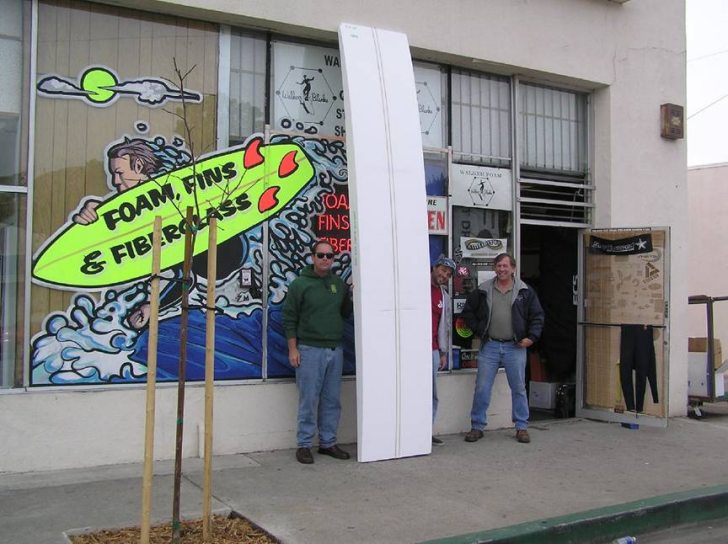
As shown above, that sweet looking 12’+ double stringered blank at the store front probably has the final rocker perfectly cut into it. 

EPS will set you free. EPS is manufactured and available in most medium to large cities with hundreds of locations to buy from. If you are incapable or too lazy to cut your own eps you can buy ready made blanks in dozens of locations. Meanwhile, the 4 non chinese PU blank factories keep enslaving the sheep.

Bahhhh, Baaaahhhhhhh, lets do it the hard way.

[quote="$1"]

EPS will set you free.

[/quote]

Haha, couldn't agree more. I tried to point this out a page or two back...

What really cracks me up is the PU/CNC industry establishment talking about their ''accuracy'' when they are hand-lamming the boards on T-racks. What a joke. Setting the rocker on a fixture is way more accurate and consistent. And twist is eliminated also.

But they'll defend it because they don't know how to build anything else.

Most PU foam will start showing a difference in hardness past 1/4" deep from the skin. Some are vastly better than others.

You aren’t a “slave” to PU blanks if you know what you are doing and spend the time to supply private rockers to the blanks you know work for what you are doing.

JM: I totally agree w/comments about Cobra factory. If you google their site you see that it is a very professional operation doing many different types of watersports equipment. The entrepeneurs like French that have partnered with the Thai government have a terrific thing going.

I agree that EPS can save a ton of work. Years ago I designed an entire blank line for myself for the designs I was doing. This is when Todd Shaver still had a machine and foam inventory to cut whatever I needed, whether one offs or groups of blanks in different EPS densities.

When Todd closed down, it wasn’t until I met with Daren Story at White Hot Foam in Oxnard, that we discussed me designing a “Utility” line that would be available to the public in return for my private line that would save me a ton of grunt labor. Not unlike CNC machining of PUPE’s, the EPS line would have finished foils and outlines precisely cut in.

Unfortunately the decision the parent company made was to close out the surfboard division and sell it to U.S. Blanks,which also purchased Austin’s program.

Bah baaaaah… agreed. Do it whatever way you see fit. It’s your board or your friend’s board, and amd at the end of the day as long as it serves your purpose that’s all that matters.


P.S. Mike… I didn’t really think this “old thread” would become out of date, but apparently I have been shown quickly to the door!

Awww, c'mon, stay a while and enjoy the entertainment you started :-)

"I agree that EPS can save a ton of work"

In the case of my ineptitude, anything but.  Like I said, if I had access to a machine nearby....


Unfortunately my attention span does not allow me to go back more than 1 page.

Great minds think alike???

 PU Shaper says “Hey, that twist is custom for “fill in the blank” break.”

 Surfer ba ram U says “hey, I want to be the first on my block with one. Make me one too!!!”

BAAAAAHHHHHHHHHHH


ENSLAVED???

My best score ever was when the 40’ container of PU Bufords came in over packed and didn’t meet to deck rocker quality assurance (way too flat) for the cnc machine. “Seconds city”

Golly GEE massar, the next container will be here in 6 weeks. Eyes sure hopes doz next ones wont be so mess up.

Meahwhile 4 blocks away at the EPS factory has  4’ x 4’ x 16’ 1lb-4 lb EPS blocks stacked 3 stories high, ready to be cut to any size and shape you want. 

EPS-mation proclamation:

“I scored some closed cell foam, seven boards ago…”


LOL.

here's my apex...


 i tried googling George riley, you tube him, to no avail

i do like EPLE by 3iO http://www.youtube.com/watch?v=H_h-UvMeKyM  which is a jazzed version of  http://www.youtube.com/watch?v=IkvXcvb7rkg

i fucked up a few things on my egg, 1 functional, 1 looks, but will i notice it in the water? 

i won-t make the same mistakes again though. i always thought pro-s don-t make mistakes, but they do, like balsa says, a pro has made all the mistakes

thank god for the jim phillips dvd-s

such a pity he won-t make more


They get mean over here in the General Discussion section. 

I meant no disrespect to anyone. 

Truth be told… I’ve shaped one boar…er, actually half a board that my friend finished. 

It was the styrofoam kind and we glassed it with regular resin.

It’s still on his garage floor.

See how fun this can be??

I grew up near Watkins Glen. I likes that apex.


My car is two thirds the one you posted.  Mine is a BM, plain ol piece of Sh%t