Dead, I wouldn't ask for anyone secrets. Just plant some seeds for me, point me. thanks.
I’m not contributing to this debate constructively at all but surfdings photo’s got me frothing out on barrels.
When we discuss such topics has rocker apex it’s important to know what style of surfing we are design the board for?
Posting pictures of surfing is always constructive just has examples of building or design.
Also note there are no secretes. A magic Rocker for California is not going to be Magic for the North Shore.
This is why Custom will always be a big part of Surfing. Making boards for different puposes and know why and how you make the different rocker adjustments is what makes this so interesting, Dead Shaper is a good example of knowing how to incorporate the design elements correctly. There really is no short cuts. It’s really a formula like chemistry. We are mixing many ATOMS of design to form that perfect MOLECULE so we think?
These are the kind of waves that make us search for the perfect chemistry:**
**
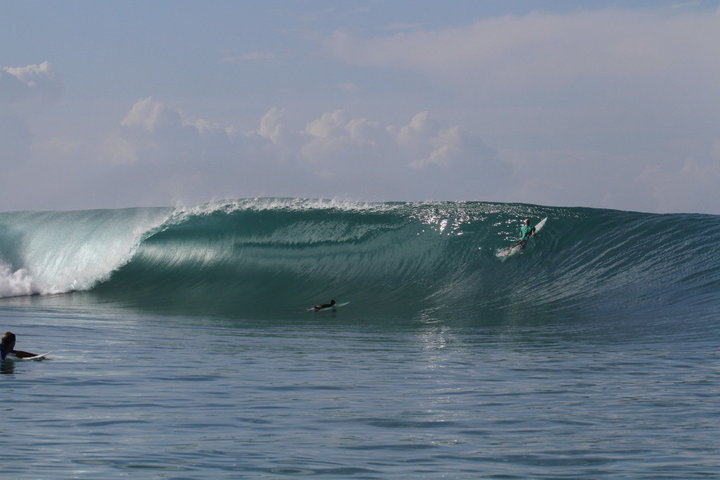
OMG… just look at that wave! The thing is sooo fine it amost hurts to look at it.
What was the old caption? “No matter how good Shaun Tomson looks on a wave, he will never look as good as a perfect one without him”.
I was thinking about Silver’s post that started this whole thread and what he mentioned JC stated some 3700 reads ago. In retrospect, and v-e-r-y generally speaking the 10" back quote is correct in the proper context. This is if you apply simple math like so: 6 ft shrtboard = 72"… center is 36"…suggested ‘apex’ is 26" up from tail…side fins up about 12" where/near back foot drives from…stance width of 17" equates apex 3" behind front foot equating apex to a lever aka pivot point for direction initiation and changes.
Further anecdotal support of this were the Aussie boyz citing Michael Peterson’s design choice. Someone quoted him as saying it was “almost like cheating”. For those who don’t know the history, MP is considered one of the greatest craziest surfers of all time from the land downunder.
At least he didin’t undergo a sex change operation like at least one other Oz surfing luminary, but that’s another story.
As far as the “apex” placement or curve considerations and how you place it for large and small waves, the JC design advice is pretty sound in the sense of general advice… forward for big waves, back for small… or even Loehr’s distinction between tubes and huge faces or small waves or whatever that distinction was… I don’t recall it word for word, but the point (I think) he was making, is that you can ride a much shorter board in a tight tube versus (other) different kinds of waves… say like Waimea.
The mistake or at least false assumption that stands to be made from JC’s statement would be to assume that placement of that apex or whatever you wanna call it solves the problem, or provides the solution, and that is that. But as Surfding states, the curves that might provide you magic for California doesn’t mean that it will net the same result in Hawaii. A shaper that does custom boards in Hawaii fro many years will acclimate and zone in on criteria even beyond that. Some guys garner acclaim for making really good Pipeline boards and other’s excellent ones for Sunset.
In kinda stupid probably incorrect predisclaimed terms I’ll coin here, the apex positioning results in a shift of watterline or ‘wheelbase’ when turning on your waves of choice. Apex forward = longer wheel base longer turn capability… aft apex = shorter wheelbase, inherently shorter turns.
Of course this is stating n-o-t-h-i-n-g about the type of curve dynamic that is accompanying your choice of apex positioning, and there are stilll guys on this thread that maintain that these is no such thing as apex. But whatever you want to call it, there are individual characteristics to each curve and dynamics that result from the curve.
And to pull it back to foil (as I maintain my description as foil being all encompasing), this has to include both bottom and deck of the surfboard. I’d be easy to agree that bottom rocker is easily more instrumental in producing a good riding surfboard, citing that deck can be pressure dented, waxed, traction pad mania applied, railsavers, and whatever other kind crap you want to subject them to… but bottoms tend to be treated with far more reverence and dignity. I guess if you wanted to slow your board down for slow waves you could wax the bottom, but I’m not going surfing with you.
Back to task: is the area straight, curved, channeled, concaved, vee’d, round? Does the tail bend more with a curve dynamic that facilitates water hooking at the end and provide a launch pad for big air, or does it straighten out for drive yet is loose enough because it is a short length of plane… it’s subjective… whatever YOU want to experiment with or make it.
Your design philosophy… your choice… or your shaper’s choice given creative license.
Compound curves.
I can’t say that enough.
deadshaper - that was a good post, one of the most logical in this thread, IMO.
Yeah, it is subjective, and a lot of guys who have found a method (of quantifying design elements) that works for them fall into the trap of thinking their "truth" is the only truth. Still, there is an element of mystery and unknown in the surfboard design arena, and I think we all benefit when we all share what we know - or think we do! Rules of thumb are way useful (esp. to shaping/design newbies like me), even if inadequate as a design truism. Sometimes things work, but for different reasons than we think. When the bonzer was introduced, I recall the Campbell bro's talking a lot about venturi effect. The bonzer design is pretty well proven, but I think everyone realizes the venturi theory was incorrect as an explanation.
As far as the "deck rocker" - it seems to me this is a very useful criteria for shapers working from foam blanks, but from a strictly design viewpoint, it has to be admitted that deck rocker stems from bottom rocker and foil, as someone pointed out, which began the whole discussion. Once a board has been designed, then deck rocker is a useful tool and reference element in producing that board from a foam blank. That's my take, not sure if I understood all the arguments correctly.
Viewpoints of some might be limited, but overall I find the atmosphere here way more open minded to design variety than the majority of the surfing world. Thankfully. And thanks to you, and everyone who has shared their design insights here! Now, I'm still waiting for Ward to tell us about California rocker vs. Indo rocker!
BTW, read about 'Westerly Windina' in the Surfer's Journal, I'm like WTF???!!!
…from the last time that I clicked on here, lots going on…
but this thread transformed how to measure? in where put the apex?..
so what s the point exactly?
-DS, that what you say about different apex positions etc is one of the reasons that I say, always, that is not possible to shape a board in 30 min, etc
you know, ALL start with the “same” plugs; if you only get rid of the crust and round the rails and some think that you just shaped a board…for all the situations…jeezz
In the end…most shapers only do that and or rely in the machine to do the other thing
Well… yes.
The are more shapers that the blank shapes than shapers shaping the blank.
Capiche?
Bottom rocker as primary?
Yes, but our point was decks of the highest order are not only or captive to be a product of bottom rocker alone. You included foil, and by my own definition that includes deck rocker as the bottom curve and deck curve enclose or complete the line that comprises foil. So more simply put, foil IS the total combined result of deck & bottom rocker and everything in side of it. And we are even talking about deck and rail contours such as flat, domed, concave, double concave, tri hulled, etc. . That is ALSO foil.
The point that Ding and I were making could be confusing or the point being missed by some shapers. The point was that consideration, registration, and duplication of the deck line from a strength to weight ratio aspect, is actually more important than the thicknessing latitudes that most of us take from the bottom of the blank.
Let me put it another way… if I am making a very straight deck line for something like a Liddle displacement hull, the deck rocker need to be very flat. To use a blank that is flat to begin with is ideal, otherwise I am faced with having the blank manufacturer flattening a curvy blank to the point that it gets a camel hump. To remove that hump I then have to plane or machine so much foam to get the proper foil that I have substantially weakened the board. If I had a load of glass in that hump removed area, I now have compromised myself in weight concentration or limited the glassing schedule that I may have wanted different. The soft area very well may cave in prematurely anyway.
In contrast, if I can read blanks and find one that was flat to begin with, or was designed in what is now called mid range rocker specs, the ability to flatten the deck curve without distortion is more possible. And, if I have read the foam correctly from the get go before starting, I know that the thickness and deck contour will allow me enough latitiude to remove the foam I need for the desired bottom rocker that I need while still providing me with enough nose, mid, tail thickness of the desired deck and bottom profiles that I had planned on.
So, ALL of these considerations must be possible before that gr8 ‘reduction process’ known as shaping even begins.
Awesome words of wisdome there ding and dead, keep them comming.
For those who are late to the rocker ‘apex party’ and confused as it’s morphed into deck rocker stuff, best off going back to the start of the thread and reading (as I had to). Starts getting good from page 3 when Barnfield and Greg get going. Greg Loehr’s theory of pitch is a must read too.
I’m going surfing…
…uhmm, I see now the new direction of this thread…
I didnt though on what you say, because is the A B C of shaping (the pre shaping stuff); remember old threads talking about shaping process, etc ; now I see that many things are not irrelevants for some
may be because too many people shaping but not taking the time to understand the process or the labor.
-may be is better to “define” an overall way to take some measurements.
I rely on eye scrutinity and feel, a lot too
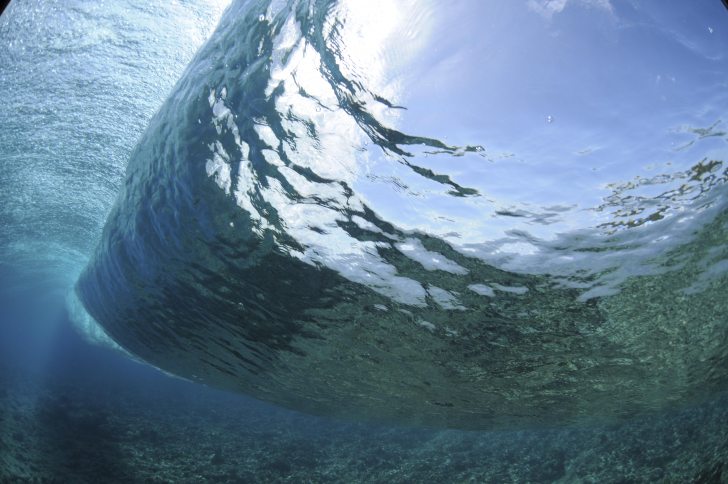
Ding that wave was disgustingly perfect…I just threw up…on the perfect wave theme…heres an underwater Maldives shot…
If Roy Stewart were around he might point out that his boards are:
1. Wooden. "Overshaping' the deck is a non-issue.
2. True 'constant curve' rockered and have consistent thickness from nose to tail.
My point? When the waves are nice, lots of designs work. For those who are happy just being in the water and who don't give a shit what the judges or the beachniks say, it's all good.
-
Yup… apples to oranges.
-
Yup. Support story #3112… one day I decided to take out Ratman’s (Kenny nowdays) Meyers girlfriend’s Boogie board at Santa Catalina (Panama). As the tide was shifting, every wave was getting better. The water was coming in over the reef from set to set, even wave to wave as happens with 17 ft tides. While all this was going on, the boogie started working unreal and I felt like I was having a GG (George Greenough) moment. Kenny, and Jimbo and Munchikin were yelling at me ** "what are you doing? Go get your board!!** I had my whole quiver sitting by the bohio. The waves were epic… but I’d never ridden a boogie board in perfect waves and I just kept riding the thing.
Tom Morey was the first person that I’d ever read in a surfing magazine to have the balls to contradict the age old belief that surfboards had to have pretty natural curves. He said it was all bull crap, and the article was accompanied by whacko nut looking engineer genius illustrations of his about-to-be stuff that shortly thereafter became Boogie boards which ushered in a whole generation of surfing flexible cubes at places like Pipeline. Tom proved that you can, indeed, stick a square peg in a round hole.
As far as this whole thread morphing into deck rocker and stuff… I didn’t mean to derail the whole idea of apex by any means. Sway’s is a sharing of ideas, and the thread evolved into the bigger picture… at least I’d like to think it has. To simply paraphrase my most recent posts here, all I’m suggesting is envision shaping the board before you shape the board. Start with the big picture then hone it down to what you aspire to.
Bill gave us a standard for measurement so we can all be on the same page… from there we can pontificate all we want, but at least we can do so in the same language. Otherwise we have a bus load of abstractions.
P.S. BTW I hate those sponge things these days. Go figure.
Yeah, we morphed this thread right over into what should be titled ''rocker measurement and design'', but it was fun.
All the talk about overshaping decks and measuring rockers the old way makes me glad I work in a new world where all that stuff is just, well, old....
Correction, it IS fun:
So, what is peoples experience with a straight flat between feet?
Or a flat back
If anybody wants more, ask me and i will put more time into making pics and posting
[img_assist|nid=1053654|title=A1 curve Mark Richardson |desc=|link=none|align=left|width=640|height=480]
[img_assist|nid=1053655|title=K3 curve|desc=|link=none|align=left|width=640|height=480]
[img_assist|nid=1053656|title=9A curve|desc=|link=none|align=left|width=640|height=480]
[img_assist|nid=1053657|title=11A curve|desc=|link=none|align=left|width=640|height=480]
Thanks to all, and especially Bill Barnfield and DeadShaper, for a great, and informative thread. So much info, have to go back and re-read, hope to absorb some of it! Thanks to those who asked the questions that kept it moving!
I found my new tagline in this thread!
“all that stuff is just, well, old”
… so is a Stratavarius.
Rocker is a Religon it’s a matter of what you beleive!
You can lead a horse to water but you can’t make him drink.
DS, what I was referencing was the measuring/cutting/shaping rocker to the nth degree in the shaping process, then hand-lamming it on T-racks where anything can happen as glass job cures. It's not nearly as accurate or consistent as setting the rocker IN the lamination process.
The old way has worked just fine for the last 40-50 years but that doesn't mean there isn't a better way....
**The old way has worked just fine for the last 40-50 years but that doesn’t mean there isn’t a better way… **
The stubborn fall behind!
Mike and SD… quite true! Particularly with the pro guys that need leading edge equipment.
Then we get the rest of the world and it reminds me of (yet) another little story.
I had some very talented friends while growing up in high school. One notable, was Kim Wilson, who ended up as lead singer for “The Fabulous Thunderbirds”. They frequently collaborated with Stevie Ray Vaughn. But there were (also) others that went on to become successful studio musicians and backups to big names. Little did I know back then, as we all sat there on Fridays eating our lunch in the quad that a bunch of these kids would become musical greats!
There was a guy named George Riley. He could play Hendrix licks behind his back and with his teeth. Later at city college, he was doing incredible creative musical arrangements. He was playing with other HS alums like Jeff Elliot, Randy Tico and Barbara Wood… the guy drank too much and sometimes fell off stage, but he was a phenom talent none the less.
I was at a party one night talking with some guys I knew that were hired to play for the party, when the lead guitarist, for some reason starts telling a story about some derelict guy that approached them on break.
“We were playing this little club in Santa Barbara called “The Spigot” and at break this guy comes up with this absolute piece of crap guitar that you would get at Disco or Crown for $20… you know, the old discount big box discount stores like K Mart? Anyway, he looks drunk, but he was polite, and he asks would it be okay to jam with them? We all look at each other with a snicker thinking ‘this should be hilarious’. So we say sure”!
“We ask him if he knows a certain song, and he says’ yeah, I’ll just jump in’.”
“Long story short, the guy just totally kicked ass, and brought the whole house down with this guitar you’d get at a five and ten. I couldn’t believe his riffs and the sound he was getting out of piece of junk! People were just completely floored… including all of us in the band…we asked him his name, and he told us ‘George Riley’”.
Moral of the story? For all the effort and diligence we can put into making the very best leading edge equipment, there’s still some guy out there that can just rip total sh-t on a piece of crap.
…MD what you say about accuracy is what I say about the fallacy about the machine accuracy 1/32 shaping PU (with stringers) and that is useless because almost all the stringers sports some type of tweaking., then the finish, etc
plus the waves that are all differents and by no mean consistents all the way.
I say this because here in Swaylocks there are people who love make simple task looks difficult or complicated trying to be literated about design as we see early in this very thread. For ex.: “that wall is White” or “…according to the
contrast of shadows and lights and from this position of spectator looking at the
wall I can say carefully that the effect caused by these variables make
the wall in a color which is known as White”
One good thing the Japs achieved is the synthesis, the power of it.
Then what DS say about some talented that have enough skills to ride or do whatever
however there s a video that shows K Slater and D Malloy, I think, in Jeffrey s bay surfing good surf with fish boards and Malloy kill the waves and is very fluid but Slater can t surf pretty good enough as he does with a shortboard…