Surfboard volume is a variable that is both quantitative and qualitative.
Surfboard volume is the product of its dimensions.
Buoyancy is affected by volume and load.
Buoyancy and width affect stability.
Stability affects ease of paddling and riding/standing.
Buoyancy affects submerged volume/submerged surface area which affects drag.
Drag affects acceleration, affecting time and distance needed to reach critical velocities.
(There are 2 critical velocities in surfing, take-off and planing.)
Most surfers like a specific amount of “float” (buoyancy) which is determined by volume, rider weight, skill level and/or personal preference.
After making some recent physics-based posts on Sways, I did a quick internet search about surfboard volume.
I found a general approximation – one (1) liter of volume for every 4-6 lb.
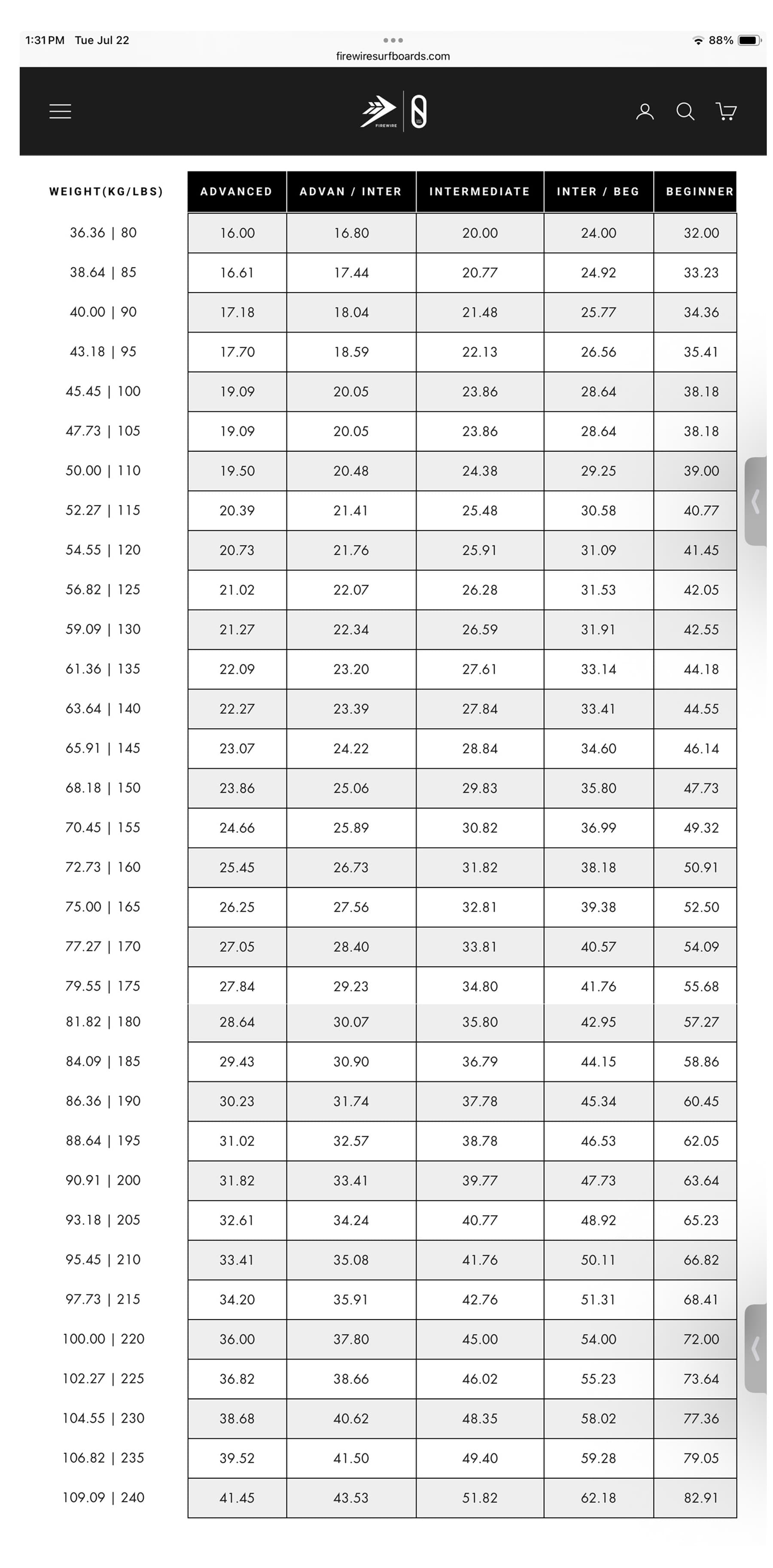
There were also several volume calculators and charts/tables.
I got this from Firewire;
I’m sure that those who have promoted the use of volume in surfboard design have very competent physics experts in their employ. Or, more like 8th grade science teachers or did they just overhear some conversation?
Truth is that buoyancy is a force exerted upward opposing the weight of the object. That is why EPS floats higher than poly for the same volume. Archimedes figured this out long ago, and Zen philosophy says this is the equilibrium of the universe.
My tolerance level for manufacturers making stupid claims has decreased exponentially with my age. My young friends that are shapers/builders with engineering skills just laugh this stuff off and remind me of my blood pressure. You decide - Is it technically qualified data or just marketing skills?
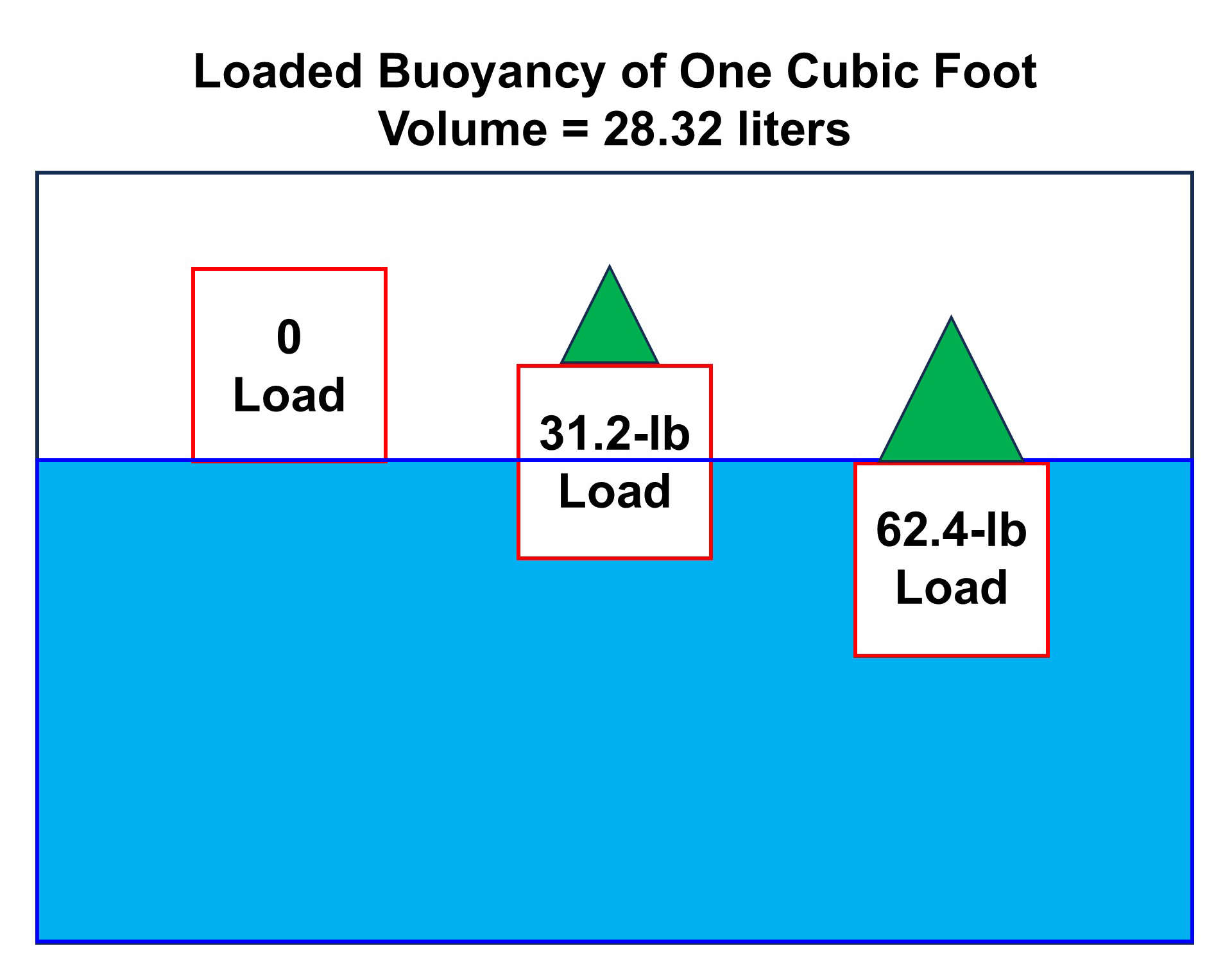
Yep. Archimedes had it quantified. Which means buoyancy can be quantified by knowing volume. And the effects of the load placed on any given volume can be quantified.
“Archimedes’ principle states that the buoyant force on an object submerged in a fluid is equal to the weight of the fluid ‘displaced’ by the object.”
And load (mass) will determine how much volume is above and below the water surface — downward force exerted on the board by a given load/mass (weight). And the more submerged the more difficult it is to accelerate forward for take-offs. More mass = more submerged volume for any given volume.
I find it much more difficult to balance (sit and paddle) on a submerged board. Or to stand up/launch on a sailboard/windsurfer.
In the dark ages (60s) board size was the vague indicator of how well a board would “float” you. Knowing what water displacement volume will “float” my weight (mass) gives me a more accurate idea of the board size that will “float” me at the water level I like.
Therefore, volume can be a valuable parameter for narrowing the board dimensions that provide the “float” I like.
Pretty sure buoyancy for 1 cubic foot of 2.5 pcf EPS is the same as 1 cubic foot of 2.5 pcf polyurethane.
My Zen readings suggest to me that Zen is a philosophy of consciousness and awareness.
For Windsurfing volume is the first charcteristic to define size of a freeride/freerace/slalom board. It’s choose in function of wind and weight and level of rider.
Since surfboards are design with cad, wich give volume, it appear on boards and became a first choice dimension for rider even if we do without for long time. As single universal dimension it’s well overated, at 40 liter i can shape a fish, a step up or an egg, really different boards.
Volume can be relevant within a narrow range of board geometry as Lemat has pointed out. However if the goal is to determine how high you will float, it is really a calculation of water line location. This indeed involves displaced volume, but also outline geometry and weight differences along the length of the board with rider sitting on it. So in analysis, the actual volume (and resulting buoyancy) you’re sitting on will be the primary factor in determining water line location, not really bulk overall volume. If this works for you to differentiate how high you’ll float within a narrow range of boards, then it use it.
According to Arctic, EPS is 16Kg/M3 and poly is 36Kg/M3; more than 2x difference.
Materials with identical densities (g/cc, lb/cubic foot, kg/cubic meter) and identical volumes will displace identical volumes/weights of water.
Arctic Polyurethane density is greater than Arctic EPS density. Therefore, equal volumes of each foam will have different buoyancies (displacing different volumes/weights of water).
I never said volume/buoyancy is the most critical variable. I did say buoyancy is determined by board volume. I did say buoyancy is a useful parameter for estimating the desired volume range for individual float/buoyancy preference. You must know board volume and density to determine buoyancy. This can be used to estimate a range of desired length, width and thickness parameters.
If surfer + board weight is 150 lb; the volume of water displaced by the board is 150 lb; and surfer weight is distributed evenly over the board’s surface (distributed over the center of mass); the board will not rise above the water surface — regardless of board geometry.
considering two boards the same model / shape
and two surfers same weight and height.
what i see when there are pro surfers in the lineup with thin foiled boards ( like 27 liters on a situacion i would go with a 30/31 liters board)
i see that them (the pros) they arch their back much more and stick more nose out of the water and paddle much stronger to move, but all that efort brings them the benefitt of when standing up and riding having a more responsive board. (anyway they surf vertical…i don’t, i surf round)
so for me the strange part of the volume tables is the expert/beginner/advanced part.
i am no begginer but i have a normal/low fitness level witch afects my choice of course.
also another thing is this tables not considering wave type/surfboard type…number of times you surf per week etc…
anyway when there was no volume tables a good shortboard for me would be 6’0 x 19.5"x2.5" with a bit of down rails and a soft single concave with a slight bump on the midle of the fins(trusther)
now that there are volume tables, the same mesurements (a bit more or a bit less) they are still good so…cheers and good waves
I remember reading a paper form a Ph.D. student where he tested the affects of volume on a board and with all else equal (Dims, rocker, etc) what they realized is higher volume doesn’t make a board easier to paddle but instead it necessitates less energy to paddle therefore over a session it will feel easier to paddle since your body isn’t as tired. Those 2 key velocities are crucial to the boards performance and many downplay the effect that volume has on those values but they certainly play a large part. As always with board building, its a balance between all sorts of things. With respect to planing and take-off speeds, I would say that the rocker (both measurements and type - continuous or staged) and width/planing surface are the 2 most important factors. However, for beginners or less fit surfers if the volume doesn’t suffice, they just won’t be able to paddle it and in the end it doesn’t matter about the other factors.