Hey all, I’m going to be tinting a gloss coat on retro style midlength soon. I checked the archives but didn’t find much information…any tips or suggestions when tinting the gloss? more surfacing agent? more catalyst? gloss coats, for me, have been tricky enough without worrying about pigments. Any insight would be appreciated. Thanks!
Tinted hot coat…BAD idea Tinted Gloss coat …VERY VERY BAD idea. If the board that you will be doing this is already glassed and hotcoated then attempting to gloss it with tinted resin will not result in a smooth even color. Due to sanding and the thinner gloss resin, you will get so many uneven areas of color that will not look good. You only want to tint the lay-up. The beauty of this is that it is the base layer naturally requires no sanding. therefor you only need worry about spreading the resin evenly when you glass. Plus the beauty of a tinted lay-up is the translucency achieved when you hot coat and then gloss over a tinted lay-up. Done right the board will looks if the glass job is at least a half inch thick. You won’t get this pearly quality any other way. Drew
1 Like
Jamie, You might want to tint a few panels on the board to get some color. What I do is after you have laminated but before you hot coat, tape off a stripe or design on the deck or bottom of the board with good masking tape. Now just hot coat that section with your tinted color, let kick,pull the tape. Lightly sand the colored area, then hot coat the whole board with clear resin. When you sand over the striped area you have given a little extra sanding insurance so you won’t grind into the colored stripe. Sand the whole thing flat and it looks great. Now where you have a fuzzy line from the color stripe meets the clear, put a pinline over that to crisp it up. -Jay
Thanks for the tips, guys. The problem is that the original lam tine (green) came out a bit splotchy. I tried to correct this with a tinted hotcoat (could have taken resinhead’s advice about tinting ‘cleanup’ panels), which sort of worked, but there are still some areas that are lighter than others. It’s a board for a good friend, so the aesthetics don’t matter THAT much, but I’d like for it to come out with an even color job. Hence the tinted gloss… any other ideas?
you can always use acrylic spray paint, then hotcoat over that.
shoulda just turned it into like a sun burst design…or an acid splash. looks like you got some work ahead of you. dj
Tinting the gloss coat won’t do you any good.Its transparent so all it will do is darken the overall color.The light spots will still show.I say ride it and have fun.It is a very common problem.
I just fix and sold No.6 fish that the paint/glass job started on Good Friday, Tragedy horrific ugly paint turn gem airbrush job, then on Easter sunday the glass, tried the psycadelic swirl on deck with toooo much opaque in color and hid my logo and the fade turned into tear drops of a dark nile blue on the lap yet again hooorraiffic looking, sanded the lap down so not to cover the airbrush lineage and taped, re-lam with full opaque violet purple 4 oz cloth (direct) cut sanded and hot coat sanded smooth, gloss w/full array of flying creatures and from the grave arose a gem 5’8" blue/purple deck w fish skin bottom oops, the sharks will love it if they can catch it, the new keels aka h-2 design @ 6degree double concaves I hated to sell her but my sander cost me 2 bills, so if this is really a friend, sand it down to the first lam and opaque it no tint, it’ll be stronger than any board he ever owned, and it’ll look like an epoxy. It’ll only weigh a little more! go thin on the hot and gloss aka thin with acetone. haven’t down loaded pics yet, Good luck. G.
Once you’ve got blotchly areas, a million tinted hotcoats won’t fix it. All that will happen is the darker areas get even darker and the lighter areas slightly darker. To save the project, you need to opaque lam it. Try and get an opaque version of your original tint color. Check the opacity using cloth and scrap foam. Put a sharpie line on the foam, lam over it and see if you can see it. Add white and more color if needed. There are very few pigments that are truly opaque, so test it first. Sand the entire board down to the weave of the cloth, and then lam it with 4 oz. Lap the bottom and just inset a deck to the lap line. If you got good hide on the lam, just clear hotcoat. If not, pigment the hot coat also.
If you’ve seen what’s happened on my tinted wood board you will see that for some reason the resin that was poured on the bottom saturated, but the resin that was subsequently moved around did not seem to saturate completely. What you see in the photos is NOT the texture of the weave due to a dry lam. It is microfilaments in the cloth that did not seem to accept resin. I’ve never seen anything like it. It does not look good (the board would have spectacular had all the glass saturated).
I know it is ill advised but could I heavily tint a gloss coat to hide some of that? It does not matter so much if the tint is not even as it is covering wood and an uneven pattern of saturation.
How much tint can you add before it affects cure?
Finally, for the future, is this something Additive F would help? I’d stopped using Add F years ago.
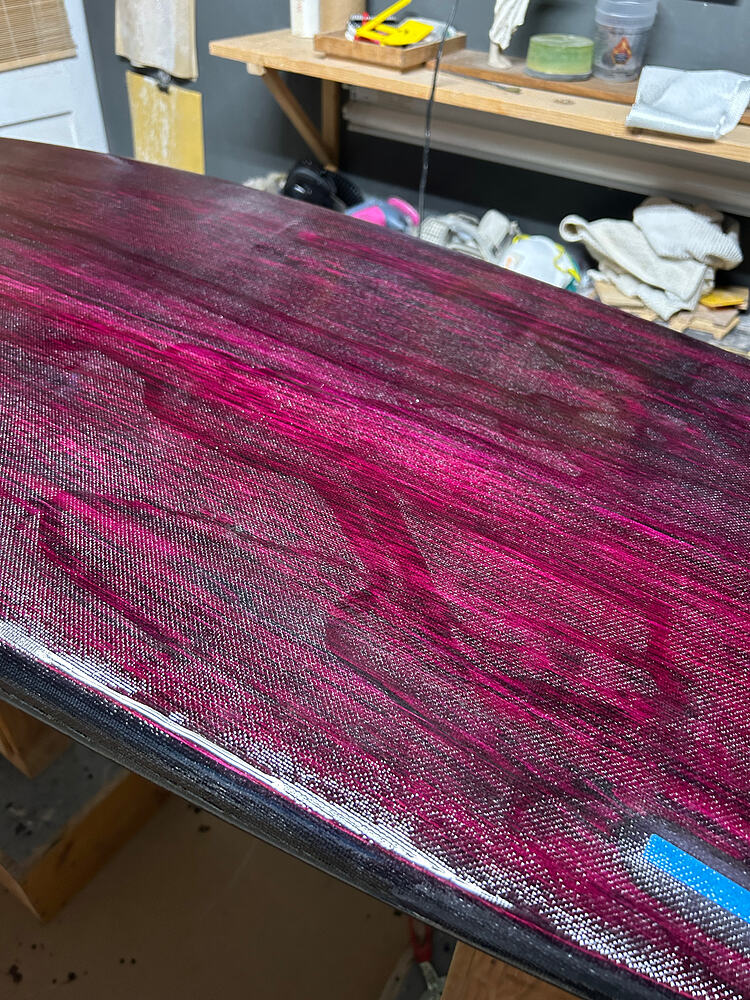
This is an example of when a shaper/builder has to say NO!
Too late for that. Any thoughts on tinting the gloss? Obviously I don’t have the necessity of a uniform color.
For sure you can tint hot/finish coat. Seems your tint react with resin no? As i said in your other post epoxy are still sensitive with support. I bet addF will do nothing right for you here.
Tinting the gloss coat has been tried many times by others. Poor or mixed results at best. Take petec’s advice. There’s not much if anything you can do now that will be anything more than a crap shoot. Sorry it turned out so bad for you. But it is a lesson learned. Water based dyes are meant for fabric. Nice experiment though. PS I don’t include Fiberglass Cloth in my use of the word fabric.
Aniline dyes — water and alcohol based — are used for wood guitars, skateboards, furniture, etc. Because the wood veneer is so thin, alcohol-based aniline wood dye may have been the better choice (dying both sides?) especially relative to wood grain swelling (shrinkage) and potential epoxy/moisture interactions. Alcohol may have been likely to dry more thoroughly than water.
Don’t remember if lillibel03 did a veneer surface pre-seal before laminating.
I think the issue was veneer thickness (quality?) and maybe wood type. An alcohol base for the dye may have helped (but I am not 100% convinced). I keep thinking about the water used to tighten (shrink) tissue on balsa/tissue model airplanes. Paper is made from wood.
Veneer may need to be pinned down taut while drying after dye application.
Can vacuum draw residual moisture out of the veneer and into the epoxy?
This project may have been the perfect storm of compounding variables. (I’m still thinking residual moisture in the wood.)
Water base epoxy primer is the product to go with. It’s build for that: mechanical and chemical stabilization of wood (and other porous materials) before “classic” epoxy fiber work for wood epoxy boat build. Cut with water it’s very fluid for deep impregnation. When dry it hardened surface and 100% compatible with laminating epoxy resin.
Can aniline dyes be mixed into water-based epoxy primer?
I don’t know but universal paint tint work.
If you do as Pete recommended and do it in baby steps you may get it just opaque enough that it hides the blotchiness and leaves the wood grain visible. I do something similar with Vector Net. I put the net down under opaqued cloth. If I get the opaque right you can still see the net through it, but it is “obscuro” as they say in the Art World. I do this because the squiggles in the net are less noticeable.