I trick I just found for myself was to make sure to cut the paper right at the edge of the pad. I used to get it close and call it good. Sometimes there would be a little extra hanging off on one side and I’d let it go. Pad spins much more evenly with less edge gouges if the paper is trimmed neat.
d m p
3m hook and loop all grades then air velvet no wet and dry
haaaa’’ the reverb paul cannon clash has me amused both are right both are wrong’’
many issues involved here and should be disscused not argued?
cheers huie
thats cool huie im totally open to it and i guess i said that people that use foaming pu are stuffing up, so thats pretty mean thing to say so i shouldnt get defensive when reverb says my boards are twisted. i can think of a negative thing to say about anything. i hear the trot of a high horse.
i sand with a block after pad sanding an i rekon if people dont use a block they are lazy tradesman
if they dont do a resin finish coat they are lazy tradesman
if they dont use extra glass around the tail they are lazy tradesman
blah blah blah
the correct way to sand is get some other dipsh!t to do it for minimum wages
Heres a bit of advice..and now I'm really starting to sound like a sandpaper sales man.
Use the right kind of paper for the job. There is a big difference in quality and style of paper. There's plastics papers, wood papers, there are general use papers, there are metal finishing papers, etc, etc.
We should use automotive papers in the surfboard world.
Also using cheap paper is doing you no good. Cheap abrasives that wear down fast and throw rock everywhere are only going to give you grief and end up taking more time to finish the project.
Use the right grit schdule. So the thinking of "golly gee I'll use 100 grit instead of 150, then go to 220....anint gonna cut it"
And yes if you sand right you can go to polish after 400 or 500. Guys in the auto world sand to 500, then go to the polishes.
And yes, always buy Quality 3M products
…Im not in any high horse fella, and Im ok with what you do, it s your route, no my way; and I sell boards…
But also I reinforce the edges of the tails with 5 layers more, nobody do that, and I do not think that the others are wrong, I think that I do what a custom expensive board should have to resist the common dings.
I bet you all my shaping tools that if you take the time and make no less than 20 tests with different combos, you ll see a difference, but may be you are one of the guys who think that you can use UV cat and surf the other day…
I have many things to say, but this is not a pissing contest so keep up the good work.
—Resinhead, I see that you have older information or you are visiting not the right automotive repair shops. The auto paint repair shops STARTS with 1500 grit and sometimes, depends on the quality of the work or the quality of the clear, etc start with 1200 grit, and go up to 2500 then compounds.
500 grit is like sanding with rocks for the clears.
I sand hotcoats the same way most every sander in most every glass shop on the West Coast and in Hawaii sand hotcoats. You boys can do it anyway you want and take all day doing one board if that’s what suits you. Resinhead is right about using automotive methods. It’s virtually the same as automotive. BUT--------- There are lots of good papers out there like Norton “Champaigne”(sp) and Mirka, Unbranded Mirka being the most commonly used in glass shops.
I love to hand finish with 3m sanding pads…
I think many “newbies” - especially if you haven’t developed sanding skills doing ding repair… I’m no surfboard builder for anyone or thing than myself, but I’m sure I’m not the only one who did plenty of ding repairs before making boards, and one can learn a lot about smoothing out lumps and getting it smooth and shiny (If you want.).
I’ve had this experiencial learning curve, and I’m sure others have, and I’m suprised it’s not been mention… You gotta sand that thing nice and smooth at the some point before you any finish coat… And maybe that’s just me. I done cheaters and in the end called it good. I guess - duh, I just remembered. - using epoxy, I can sand my laminations as smooth as I want before I do a fill/sand/finish coat all at once, with the goal of only having to lightly clean up that coat. If I want the whole thing shiny I do a spray finish…
yea blah blah’’ sand it now sand it latter all part of a bigger picture
i do hope this discussion was about pu polyester? if so the twist factor has a few more factors than the hot coat.
there is a huge difference between a wet sanded finish disposable peice of shit practised by most get rich quick vagrents.
and a well made board with a true gloss finish (oh and it sells boards) this board will only polish correctly if sanded flat
you get that word flat and right here is where i agree with reverb to sand flat let hot coat harden.
to make a worthless peice of shit do it with uv sand it in quick time go surf a new board every swell’’
and there is nothing wrong with that.
BUT dont come on here and tell me you can wet sand a hot coat and have no bumps and mybe it does not matter
bad habits will slow your progression unfortunatly?
as a shaper for a long period i can tell you that to get a sander to sand your boards dead flat retaining your whole concept
is not as flippantly easy as some on here suggest’’ i have trained many and treasure the good ones.
for those of you who want to talk epoxy on this subject start a new thread i have some oppinions i would share
this is neither an argument or an attack on anyone .
just a fair dinkum oppinion of one person
**
**
cheers huie
Hell for polishing…nobody uses I paper. I know that!
Sanding meaning for color coat only go to 500…assuming you have a perfect surface…But we never have perfect surfaces. If you have a perfect surface, then you can use the 3M de-nubber.
Ok time to let the cat out of the bag…
Paint finish full panel process:
-
Initial defect removal texture match. Use P1500 3M trizac with damp DA or 3M P1500 hookit #PN02088
-
Scratch refinement. Refine the P1500 scratch with DA and P3000 3M trizact Foam disk use damp with soft interace pad, #PN02085
-
Compound. Wool bonnet with compound at 1200 rpm. Compound #06085
-
Machine polish…black top . Use 3M black foam pad with Perfect It machine polish #PN06064
-
Ultra Fine Machine Polish…blue top. Use 3M blue pad with @1200-2000 rpm. Perfect It Ultrafine machine polish #PN06068
-
Final detail. Perfect detail cloth #PN06020, comes 6 to a bag. Hit it with 3M Perfect it Clean and shine #PN06084
if you want it done right, then do this. But what do I know?
haaaaa’’ and if the sanding job was not up to scratch all a waste of time
polyester different to lacquer
cheers huie
I am up to this stage on my current build, dry sanded poly finish coat by hand using 180 grit, as you can see its about 95% smooth with scattered small shiny spots.
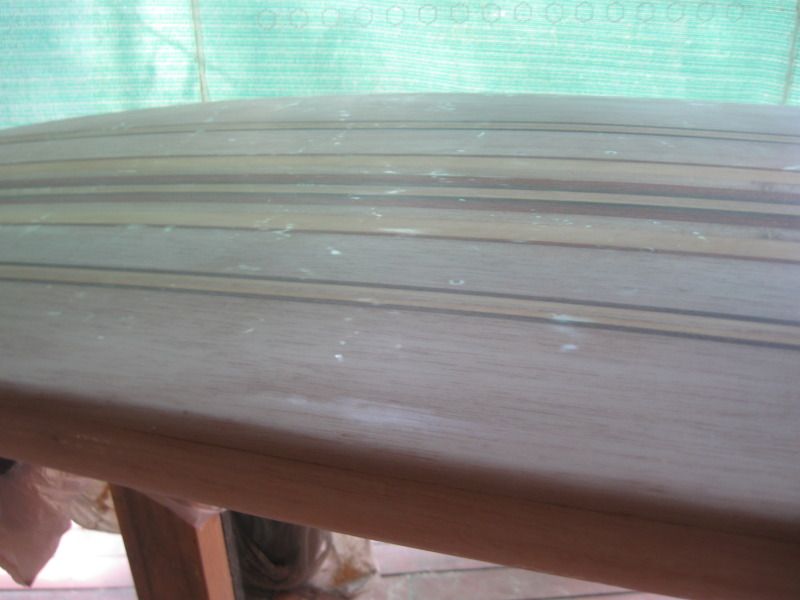
My question is do I go over it again with 180 grit or start going finer grades, in other words at what stage of sanding should there be no small shiny areas.
[quote="$1"]
My question is do I go over it again with 180 grit or start going finer grades, in other words at what stage of sanding should there be no small shiny areas.
[/quote]
Answer:
When it is flat there will be no shiny spots.
I like to get the board flat and no lumps or zit holes. Then worry about the scratches. depends on the degree of shit messing up your gloss coat
If thats your poly gloss coat...then you need to work on getting your dust and contamination down.
Huie - I’m not into a new thread, but I realize there is a difference between pe and epoxy. I think there are some sanding skills that cross over.
**yea my comments originated from the twist discuscion **
**epoxy different lacquer? where does it all end
**
cheers huie
Thanks Resinhead.
Here is a link to your fine 3M products.
Ah ha Huie - I over looked that, as I let my epoxy lams set in the warm rafter racks for a week, or so, before I do anything else…
And, as you pointed out, from sanding to??? Hard to keep a discussion on sanding on track if we start talking about cure time, glue types etc… Granted they are related - it seems like we, as I think was pointed out, need to be clear about what we are talking about…
Run the pad through the middle of it left and right. Not top and bottom.
Howzit Bill,You took the words right out of my mouth. Aloha,Kokua
Going to try that this time. Nice boards!
Harvaard was asking me how to do the cheater coat…
i usually grind my lap after lam with a dremel type tool with 60 or 80, very carefull not touching the foam or graphics.
after i do a “cheater coat” with sanding resin over the lap and over the fin plugs. put a tape edge so you can have a hard line already.
sand with 150, its better than 100. flat and hard pad.
after put a bit lam resin on the rails, very thin coat, do your hot coat as usual. you will have enough meat on the rails to not sand through and the board will stay nice and light with a beautiful finish.
if you absolutely want to do a gloss dont do the lam resin on the rails, not needed.
cheers!
louis