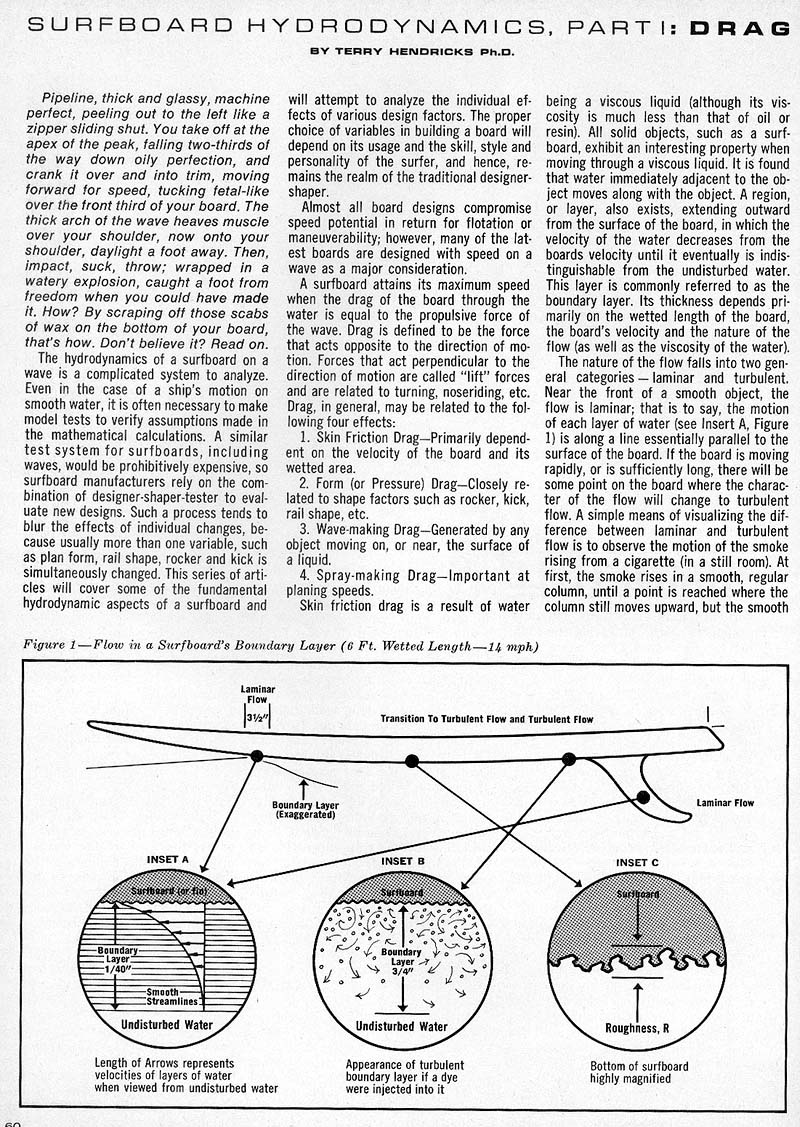
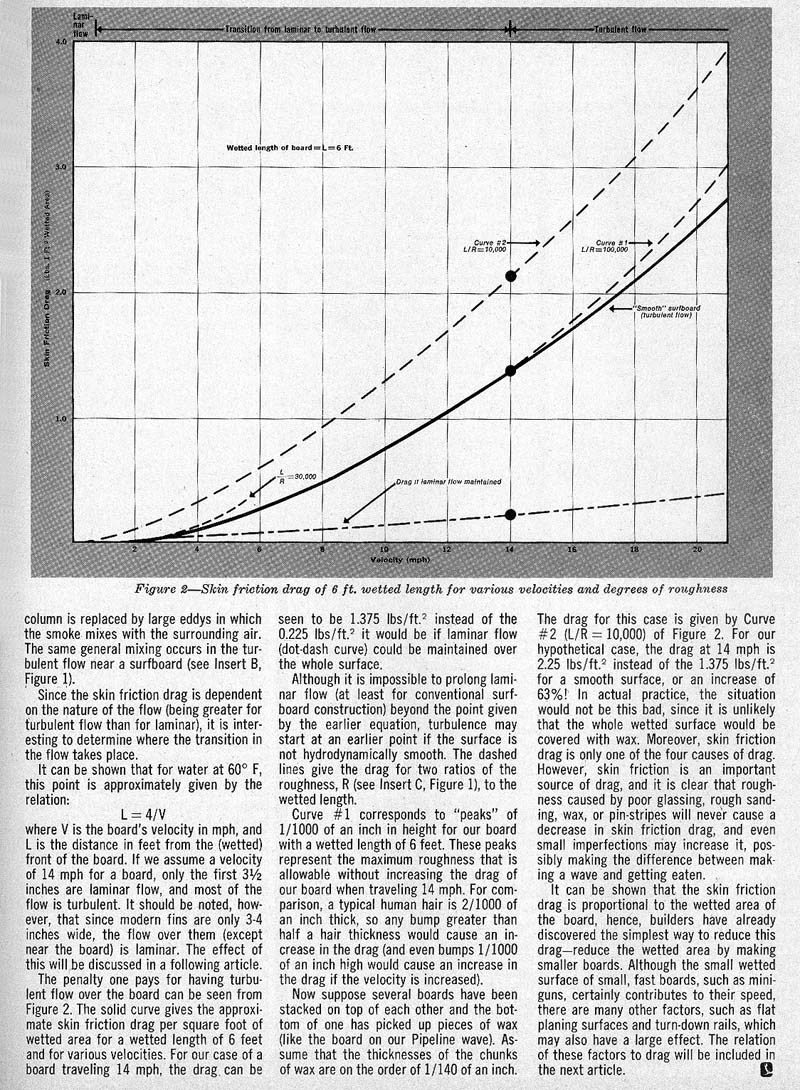
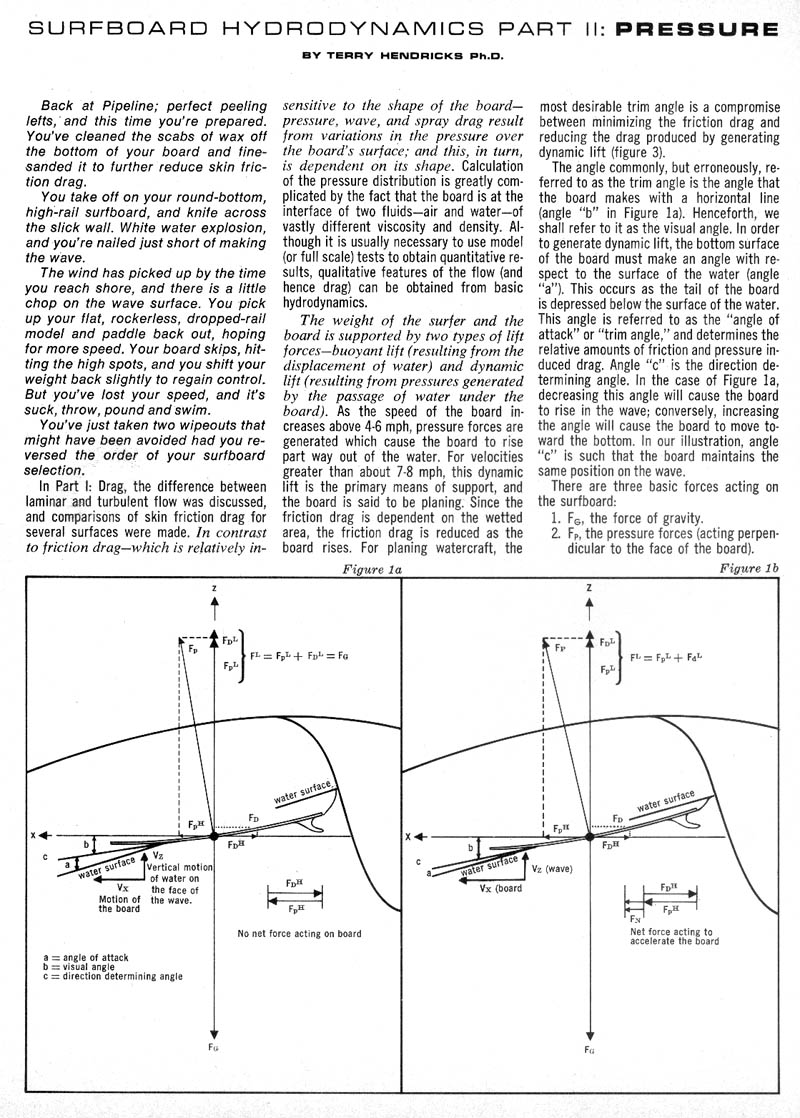
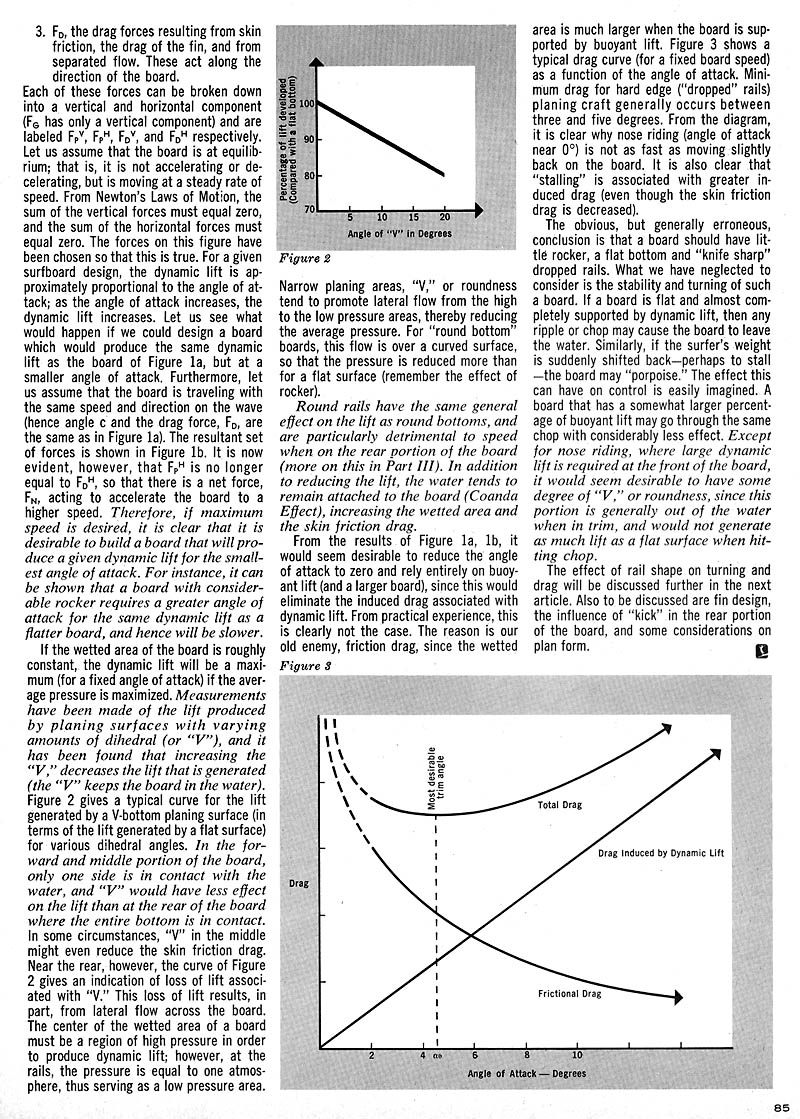
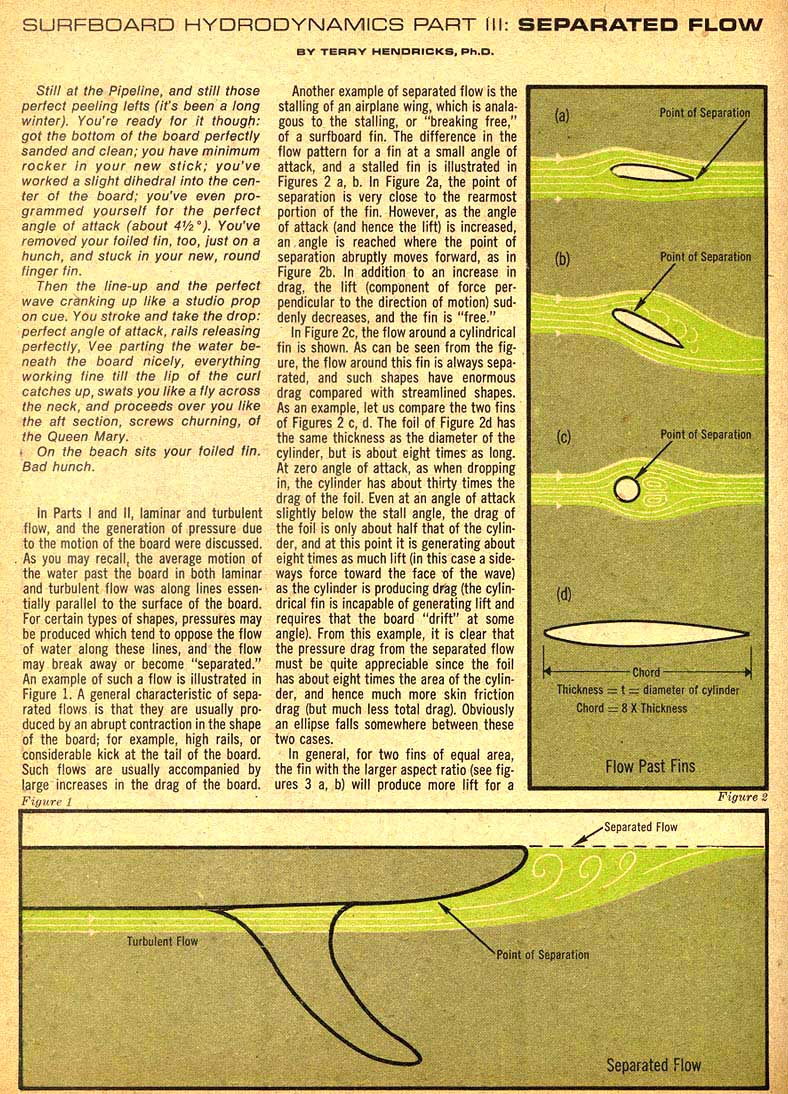
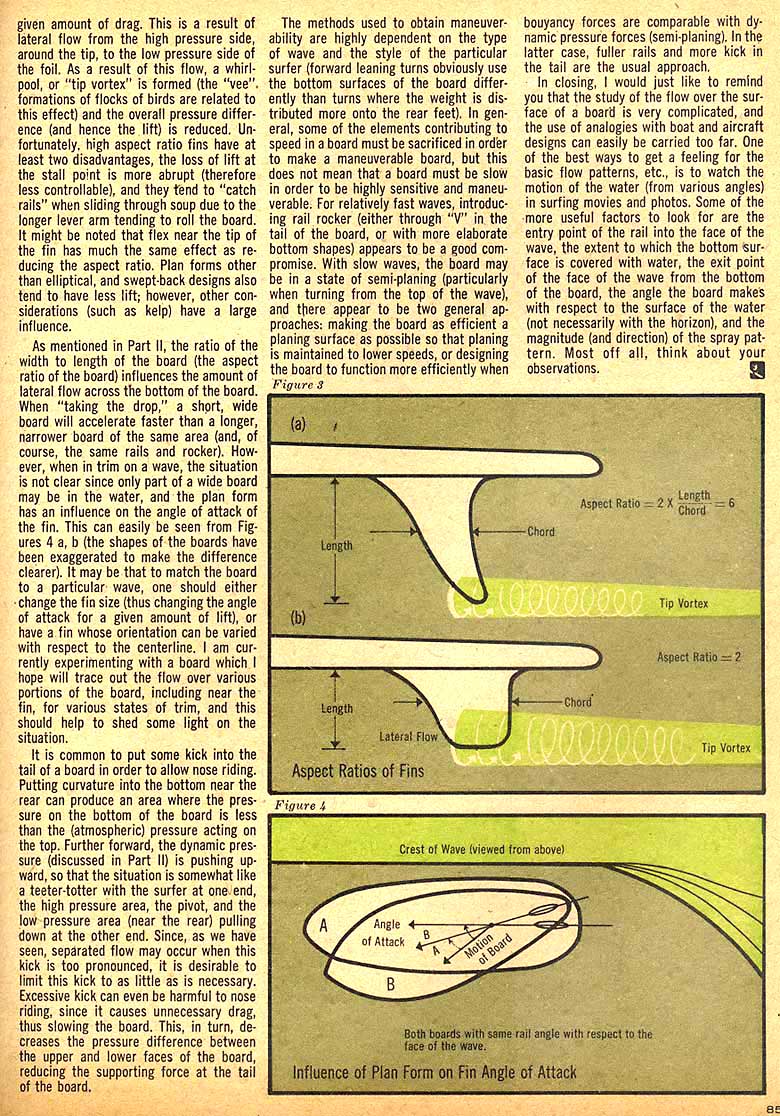
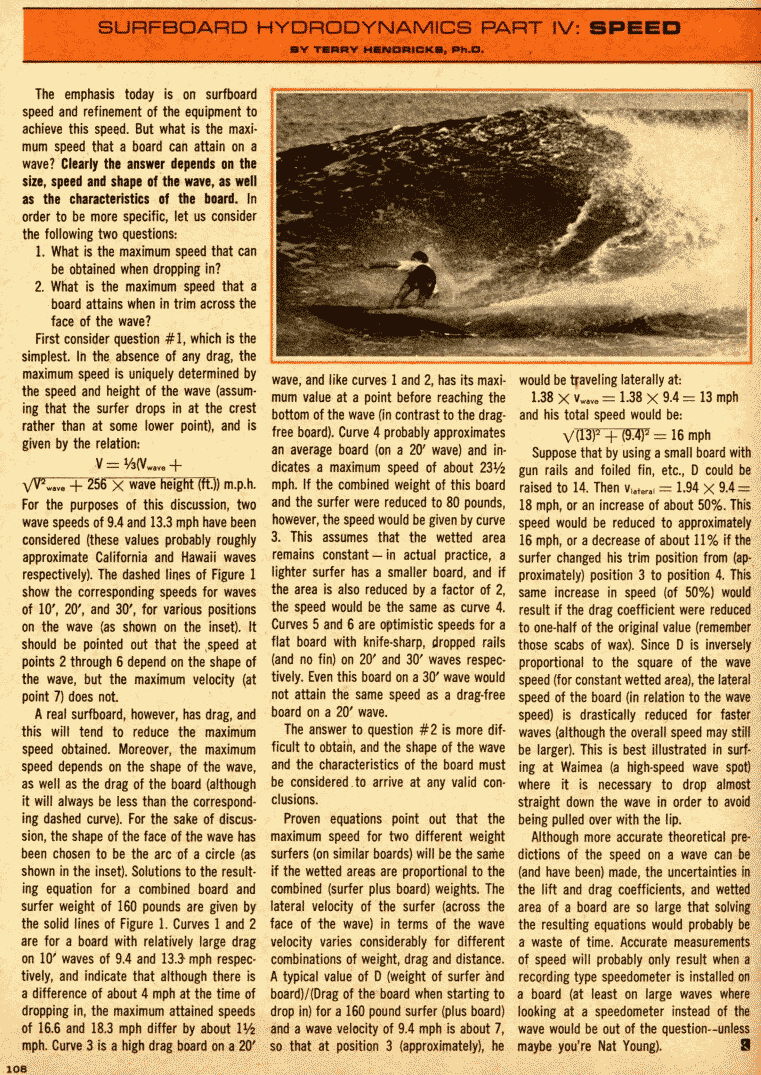
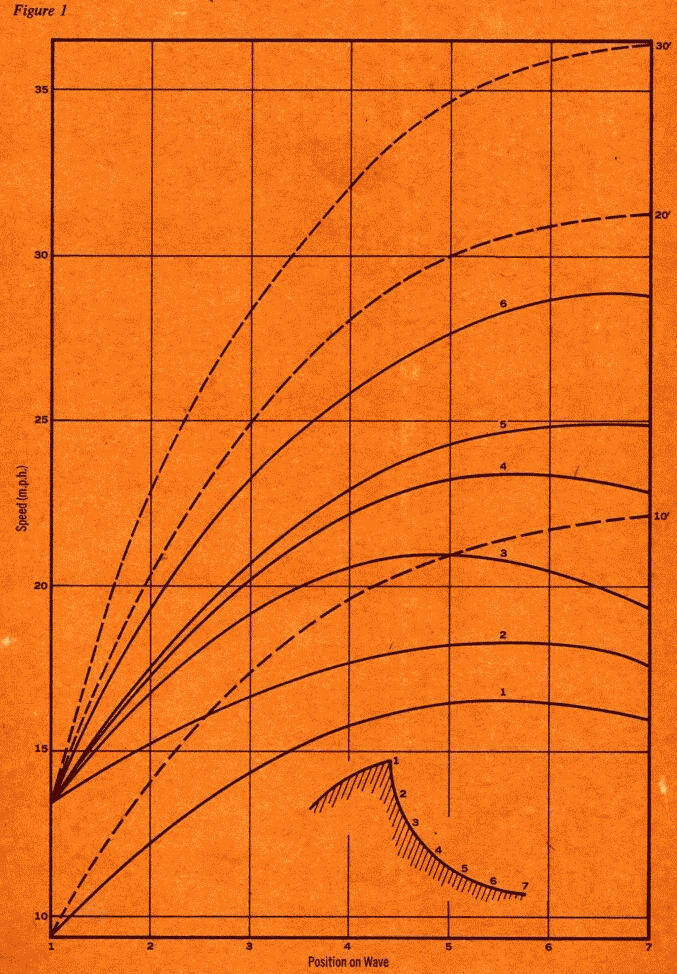
All of this brings me back to where I thought it was all about drag…
could i find a shape to reduce drag so i could lift ?
would the drag haul me over the falls before i could get down the face…?
But when riding the hydrofoils its quickly made clear that drag is nothing, lift is the element of most concern…
Low lift is cured with a bit more speed but there’s no immediate cure for a massive increase in lift when you’re less than half way down a wave and already bouncing out of the water.
How the hell can a piece of Aluminium lift me clear out of the water and have the same speed as a modern shortboard too !!
I don’t think drag is a problem, the enemy for hydrofoils is lift.
So would the solution be a foil that has a lift area that decreases with velocity but remains submerged? A variant of a water piercing foil.
But once you solve the progressive lift problem, high velocity drag must be addressed.
How much surface area is required for planing as velocity increases? Perhaps we need a progressive velocity foil combined with a small planing surface for higher velocities.
I do not mean reduced lift. Progressive velocity foils would reduce surface area and maintain the same lift as velocity increases. Ideally they would also become more streamlined.
I cannot say how stable what I am working on would be at high velocity. There is only one way to find out for sure.
I believe this is doable and not all that complicated a design either. I think I am very close …
Bill, if you need someone to confirm your designs I’m happy to replicate your designs and test them. But if you can get your ideas in the water you’ll know soon enough if you’re on a winner !
At the moment, my designs are all rough sketches like I posted earlier. I am still pondering, re-evaluating and refining in my head. I think you can see why I like to mentally design repeatedly before I build. I came up with a new little tweak while writing my last two posts.
I have a couple (probably strange) ideas, and I have no idea if these would work.
Thruster foil arrangement? No idea why it would or wouldn’t work. Just something silly to try.
Get this under a noserider? You could noseride way above the wave or something strange like that. Throw it near the nose and replace the concave’s function with it. Maybe even a little one, just to make the nose really sit up there.
" if 250 sq in lifts 80 kg at 5 kph then at 10 kph only 63 sq in are needed then at 20 kph then 15 sq in are needed " hi brett ! that is interesting …[ how did you arrive at those figures , originally ? ] so , for a rider of 60kgs or so [me] , travelling at least 10kph , on my brother’s 6’3 board… what would the square inches measurement be , then ? cheers ben
You need somewhere between 2.5 - 3.1 sq. in./kg at ~ 3 mph (5 kph). Quarter this for each doubling of speed. However, you need the larger surface when you take off to initiate lift at low velocity. As velocity climbs you need less surface area. This is why we want progressive velocity foils that reduce surface area and remain stable as speed increases.
As Brett mentioned elsewhere, the quadrupling effect comes from a standard lift equation. Swied proved it in one of his posts:
Stoneburner, The question you posed earlier for comparing an airfoil to a hydrofoil is for equivalent Reynolds numbers, you can expect near equal performance. Surfboards just happen to live at Reynolds numbers that are very close to low speed RC aircraft. A surface piercing foil is a great way to reduce lift as speed increases, as the lifting area will decrease. If you still have too much lift at speed, introducing washout (foil twist to manage AoA) or a change in foil (make the foil more symmetrical the further down it goes). How are you guys planning on addressing stability issues? Decalage is probably the single most important angle in a positive stability configuration of two foils. Hydrofoils are tough. You are essentially designing a plan to fly in a ‘water tornado’, but it has to stay within +/- 6 inches of the tornado’s surface, have positive stability, and be easily controlled with simple weight shifts, as maneuverable control surfaces would be too complex…I really dig this thread and all the contributors. JSS
This is the track my designs are on. I have already begun to modify the design I was alluding to with Surffoils. There is little doubt in my mind that my current rear stabilizer foil will hydroplane at higher velocities though.
Stabilize? Good question …
I told Brett I wll try to post something visual regarding my designs in the near future. But this week my job is demanding its pound of flesh. And I must mow the lawn now before the clouds burst and I am rained out.
Regarding tornadoes:
I do not think of waves as liquid tornadoes though. To me, the water movement in the wave is more of an updraft motion on a liquid hill that is moving forward. When the wave face angle becomes steep enough (slope of the hill) and paddling speed has reached critical velocity, gravity causes the surfboard to start sliding down the liquid hill. Because the wave form is moving forward the surfboard can also travel laterally to the propagation direction of the wave form.
This is a conceptual, full size cardboard mock-up of what I was seriously considering at the middle of last week (yardstick underneath). This weekend I decided it needs significant re-design. Total foil surface areas are calculated to lift 84 kg at 2.5 sq. in./kg, total area adjusted for angled foil surfaces.
The front wingtips for this design would be angled significantly downward at the black lines marked on the foil – tips not angled in picture. Wingspan of the front foil is 21" with tips not angled downard. The horizontal section is the low velocity secion. In theory, the down-angled tips are the progressive velocity portion for higher speeds.
But I am certain the rear stabilizer foil would hydroplane at higher velocities. (Maybe a hydrofoil-hydroplane hybrid would be something worth exploring).
I am thinking a front foil with down-angled, elliptical tips (below) is closer to what I want (symmetrical). Elliptical tips had much cleaner lines than parabolic tips. They give me some streamlining, and more area to work with than triangular or trapezoidal tips. And I can still have a rectangular, low-velocity horizontal foil section between the down-angled tips.