Theory; Is Added Tail Width Faster?

Bill a

agreed

i will try to mellow my comments

as a novice builder

from my perception in mushy surf,

and i build wide tailed flyer shapes

i find the wider tail initialy faster on take off

this is purely related to more planning area and volume

for a shortboarder who rides off the tail

still

it has little bearing on the overall performance on the board.

while i think more volume is a good thing in tails,

i still prefer more thickness in the equation than width.

in saying that, most of my thrusters are between 14 3/4 and 15 (pretty wide for a 6 2" however im pretty big)

i prefer the slightly narrower and thickest one of all my boards,

as a good all rounder up to double overhead ,even if the waves are hollow

tails in action…

watch

compare

learn

Wide tailed ultra short board (Earl Petersen Fireball)

Curren Indo - The Search Series

Narrow tailed ultra shortboard (Lopez tow in)

Laird Hamilton Jaws - The Day The Ride

One guy using his super natural ability just to survive

One guy using his super natural ability to hotdog when other’s are just surviving.

pretty much says alot to me…

but then again maybe I’m just weird noticing these things

…well, Bill, I know that part…but make sense that with a narrow tail in a gun, you control better (at top speed), due to the facts of the length of the board and back foot size, than a wider tail…or not?

…most semi guns have narrow tails…ok generate speed reducing drag, but for me the control is the essential stuff right there, cause at these speeds, you dont need generate speed, you need to control that speed. in small surf you need to generate speed, and for me its not good a narrow tail in a shortboard to generate it…

Quote:

All generalizations are false,including this one.

samoan guy

so fa … was so good

his chinese cousin:

how fa worked in the tiger balm factoryshipping department.

the brother that moved to germany

Too Fa.

Hey Dat’s like me and my bro… the fa’au bruddas.

He stay waytu fa’au and I stay tu fa’au.

Sometimes we no sit so fa’au, we stay insai.

they told me in apia

fa’a samoa,

the samoan way

…ambrose…

what a bitchin canoe design

Quote:

However having an extreme, drawn out narrow tail can also be uncontrollable.

Bill, I don’t know what you have been doing with your extreme pintails all these decades, but you must be making a mistake if you find them uncontrollable . . . .extreme pintails give very accurate control with minimal effort, and they are very easy to design, almost impossible to do it wrong I would have thought. Regards, Roy

Quote:

in small surf you need to generate speed, and for me its not good a narrow tail in a shortboard to generate it…

Hi Reverb,

Not disagreeing, just offering a slightly different slant on the generating speed in small surf bit . … . .my idea being that you can get your area in the tail if you want to, or you can get the extra area further up the board for a similar effect, the main difference being in the way the board turns. … . the wider board with a pintail will do accurate carving turns quite effortlessly, but over a smaller range of angles. … . it won’t turn as sharply, but within its turning range it turns very precisely and without fuss.

But to put a pintail on a shortboard without losing speed you have to make it wider at the widepoint by several inches or you lose the area necessary for speed. . . and also by cranking the maximum width up you get more curve in those long tail rails. . . . widening the limited range of turning angles which the board can achieve.

The usual myth is that pintails are hard to turn. … this isn’t true, they are very easy to turn, but only within a certain range. . . . . this can be an advantage, or not, depending on the rider

.

…yes T Bloke, I agreed with that…

…but with smaller shortboards to ride small surf and the guys trying to do all those type of rad tricks in short radius, and focus on generate speed and loose (small and shorts turns) in my opinion in these particular cases, is not good a narrow tail…

…in the other cases (like your boards) to describe long turns, etc, possible is good…

…well R Machado have a board (“thumb”) that sports wide nose and narrow tail, but you need to surf (your stand up position for ex.) like a fish type of boards, due to the wide nose…also these type of boards to surf small surf, are shorter in length…

Aloha! Haven’t seen any mention of “wetted surface” as a drag inducing factor of a wide tail. I’ve found that although wide will plane faster, that narrow actually is more “wiggly”, you know- rail to rail. For instance, one aspect of wings was to tighten up the tail from fins back, while maintaining width in the fin zone. How about the “stinger” design, an extreme variation of this theory. Currently, a “bump wing”, a little more up, offers the desired effect, a combination of both. And how about the added lift of concave as a way to increase tail speed? Aloha…RH

YA’LL ARE WRONG!

Just Kidding…

Im reading this thread and told myself I wouldnt get involved but Im sensing guys disagreeing when you are in fact, agreeing when all issues are taken to account.

Here’s a ‘fair’ summary:

  • there’s top speed and then there’s average speed. Two COMPLETELY different things.

  • Wide tails work for modern SHORTBOARDERS, BECAUSE THEY ARE RIDING OFF THE TAIL

  • A short board works as it should (assuming a competent shortboard rider) because youre pumping/driving the board off the lower half, where the fins and tail are located. The wider the tail, the more pump leverage the rider has as his disposal.

  • Generally speaking, width, regardless of where it located, aids in lifting the board out and gets it planning faster = higher avg speed.

  • the argument of narrow big wave pintails generating more speed because of lower drag is putting the cart before the horse…ITS THE WAVES POWER, COMBINED WITH PROPER HARNESSING OF POTENTIAL ENERGY, i.e. dropping from the top to the bottom, that generates speed.

  • Reverb is correct IMO…narrow tails offer more control at higher speeds. But fins have a major role with that control feature. A narrower pintail tail allows more fin area to grab when banking/railing the board…more fin in the water, more control.

  • narrow pintails are usually thinner railed, which aids control.

  • narrow pintails allow a longer rail set, which aids control.

  • Roy is using width forward of center, which suites his style and equipment preference. Doesnt make Roy wrong, just different in his personal approach to riding eq.

I ride modern mid-guy shortboards. My opinion is that wider tails offer better lift to catch more waves and higher avg speeds in avg everyday waves. How the extra width affects turning speeds depends a lot on the rider’s ability. If higher avg speed was everything, lots of guys would be riding extra wide boards…but they are not (a lot of guys should tho). Rail to rail action is slowed by more width, and many guys dont like that. Wider tails are sometimes harder to bank into a turn because of more resistance to that motion and reduced leverage from the rider (foot is further away from the sides).

It still comes down to taste…for me its 6’4 x 19.5 x 14.6T, 11.5N

HTH

Roy,

For sure you don’t know anything about what I have been doing, and there are no “my extreme pintails.” My comment refers to extreme designs of other builders. In case you missed the prior discussion re: Pintail-vs-Squaretail, I’m solidly in the squaretail camp as it relates to performance. Pintail guns however, are the most beautiful of surfboards, in my opinion. You are extremely mistaken in your comment “…almost impossible to do it wrong…”, I see I done all the time by people who then proudly post the photos here on Swaylocks. Sadly many people on this forum are inexperienced novices, who are easily influenced and misled. There are many spurious claims made about design superiority, and performance, that show a lack of integrity on the part of the claimant. Presumably for money, or status in a local peer group. I don’t need either. I stay involved to ammuse myself. For the year 2006 I will make two solid balsa boards, one to ride, and one to be stored, or donated to a surf museum. I will make another four or five foam boards for others. That’s it. There are others that would like to have me make a board for them, but I pick the customer, they don’t get to pick me. So I don’t have an ax to grind on this forum, except to pass on GOOD information.

Quote:

Currently, a “bump wing”, a little more up, offers the desired effect, a combination of both.

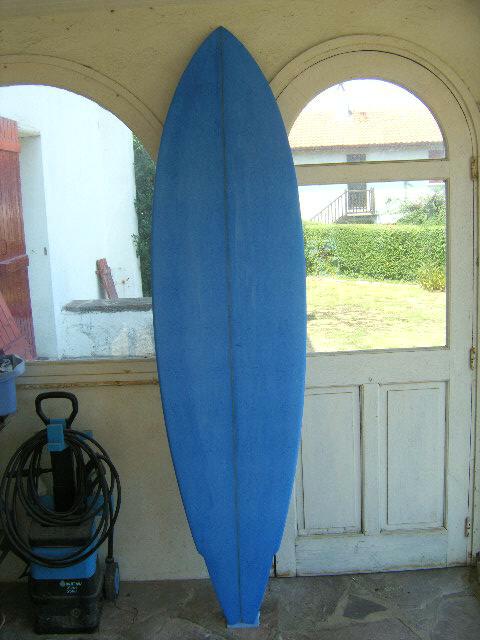
Just to illustrate this, it so happens that I have been working on this '75 retro design. Glassed it today. Complete with flattish rocker, beak nose, dome-deck and down rails, not to mention 3 1/2" thickness…

Wide tails are faster. Narrow tails add control in bigger steeper waves.

When waves get steep and big, you don’t need the board to be fast - you need to be able to paddle in, then control the power and speed that’s generated by the wave. Wide-tailed boards spin out in steep waves. Pintails allow the board to get on edge in critical sections where too much tail gets in the way.

Overall performance is determined by a combination of elements including template, rocker, bottom contours, rail design, fin shape and placement, etc.

I like to ride wide tailed boards on slower mushier waves. They give me the ability to turn quickly through the slop and put myself in the sweet spot on demand.

When the surf gets more serious my tails get narrower. I still like to stay on the wide side since, with the right tail rocker, the board will stay looser. On some waves at some places - mostly north shore of Oahu or Kauai during winter swells - I’ll trade manuverability for survival.

Ride what feels good. For me, most of the time that means moderately wide tail, low entry rocker, generous tail rocker, hard edges in the tail, smallish fins placed forward, some concave to vee or double-barrel out the back. My ultimate goal isn’t to go as fast as I can, but to control precisely where I am on the wave at all times. I’m not racing the wave, I’m interacting with it - and hopefully ripping it to shreds.

Well, I do have experience too, and I have surfed wider and narrower tail e nose boards for some years.

So, to a given wave, given rail, given bottom profile, given board size, given width, given fins etc.

Just changing parts:

Wider the tail: more turnable the board is, tail lifts more, good for people who puts more pressure over the tail, shorter the lines drawn while surfing, harder to sink tail (that’s the deal with fish boards).

Wider the nose: more drivey the board is, nose lifts more, good for people who needs more paddle power and puts more power on the front foot, longer the lines drawn while surfing, easier to sink the tail, just compared to the above paragraph.

Full wider board: at top speed, more difficult to go rail to rail, harder to sink.

Full narrower board: at top speed, more easy to go rail to rail, easier to sink.

Full wider boards: at slow speed, earlier lift, early achieves highest speed possible on the given wave, more stable.

Full narrower boards: at slow speed have difficult to get going, does not achieves highest speed possible on a given wave, less stable.

But… there are so many variables to put in the question that can change the characteristics of the “given” wide tail, that makes me agree with Ambrose: that’s a very doubt question: in my humild opinion, it’s impossible to say yes or no. Yes AND no.

J.

Balsa, nice board have you being hanging out with Terry Fitzgerald :wink:

.

I wish I had, Roy!

And if ever he reads us, he’s welcome any time…

Thanks for your kind appreciation, BTW. This one was made for a '70s single-fin fan and I had a lot of fun remembering how to shape extreme dome-decks and stuff… It also reminded me how hard it is to glass wings and swallows…

Quote:

Wide tails are faster. Narrow tails add control in bigger steeper waves.

When waves get steep and big, you don’t need the board to be fast - you need to be able to paddle in, then control the power and speed that’s generated by the wave. Wide-tailed boards spin out in steep waves. Pintails allow the board to get on edge in critical sections where too much tail gets in the way.

Overall performance is determined by a combination of elements including template, rocker, bottom contours, rail design, fin shape and placement, etc.

I like to ride wide tailed boards on slower mushier waves. They give me the ability to turn quickly through the slop and put myself in the sweet spot on demand.

When the surf gets more serious my tails get narrower. I still like to stay on the wide side since, with the right tail rocker, the board will stay looser. On some waves at some places - mostly north shore of Oahu or Kauai during winter swells - I’ll trade manuverability for survival.

Ride what feels good. For me, most of the time that means moderately wide tail, low entry rocker, generous tail rocker, hard edges in the tail, smallish fins placed forward, some concave to vee or double-barrel out the back. My ultimate goal isn’t to go as fast as I can, but to control precisely where I am on the wave at all times. I’m not racing the wave, I’m interacting with it - and hopefully ripping it to shreds.

WHAT HE SAID! This is about as close to what I think and like when designing boards without saying it myself.

the governing body of the

Association of mentally Arthrytic Retired Persons

Has determined standard dimensions

for the contest ready surfboard.

As we all know anything over 9’ is a long board,

as established by whoever those guys were that watched Dale 'skid row’dobson ryp it up and give him trophies and endorsements.

now back to the Regs

tails will not exceed 12’’

anything more will be called ‘wide’

narrower they will be called guns

and restricted to Racing war spots

noses will not exceed 16 ‘’

greater than that they will be called noseriders and restricted to

noseriding events and noseriding spots

narrower they will be called no nose

and outlawed in polite company

as dangerious to health and well being they

will be restricted to use in areas where helmeted congregate.

these guidelines will be enforced by red trunked

regulators at all beaches called ‘events’

zones for unregulated surfboard use will be

outside the areas not served by regulated

surfing board, body, and swimming times.

all violaters within regulated areas

will be outlaws and sumerily hunted to indistinction.

Permits to own exotic surfing apparatus

must be approved by the ruling surfing council.

the council for the betterment of surfing

will meet in the caucus ante rooms

where cash wil change hands

surepticiously

park between the lines

adhere to paddle out reservation times

check in at take off spots every paddle out

leave water to urinate,and tithe for every set wave you take

to the wave tax machine on leaving the strand to return to parking lot.

Th association of mentally arthrytic retired persons

has your best interests at heart

and remember it hurts them more than it hurts you ,

you know to catch all the set waves with out paying.

any questions please phone for recording

at 808 245 6001

leave message that will never be returned

…ambrose…

—not—
I second Ambrose’s guidlines except for the one regarding getting out of the water to urinate. Mike

Roy, I watched the video that you posted. Have you ever thought about making your boards out of foam to reduce the weight? Do you run hard edges in the tail of your boards? Hard as in, nice crisp edges? …-Carl