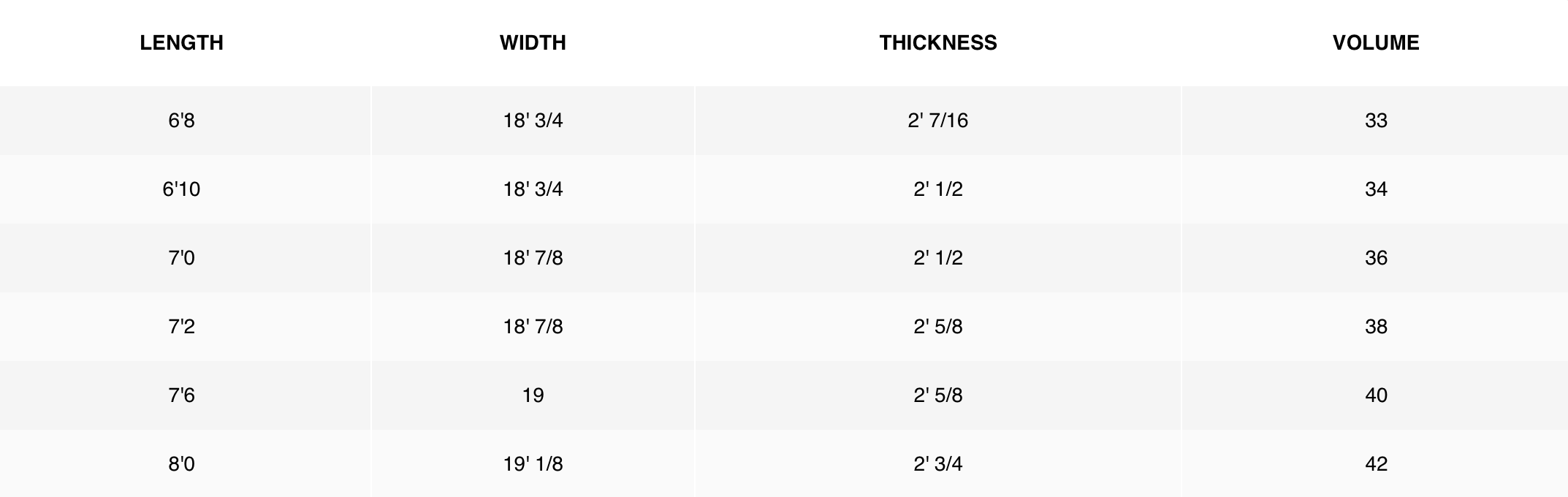
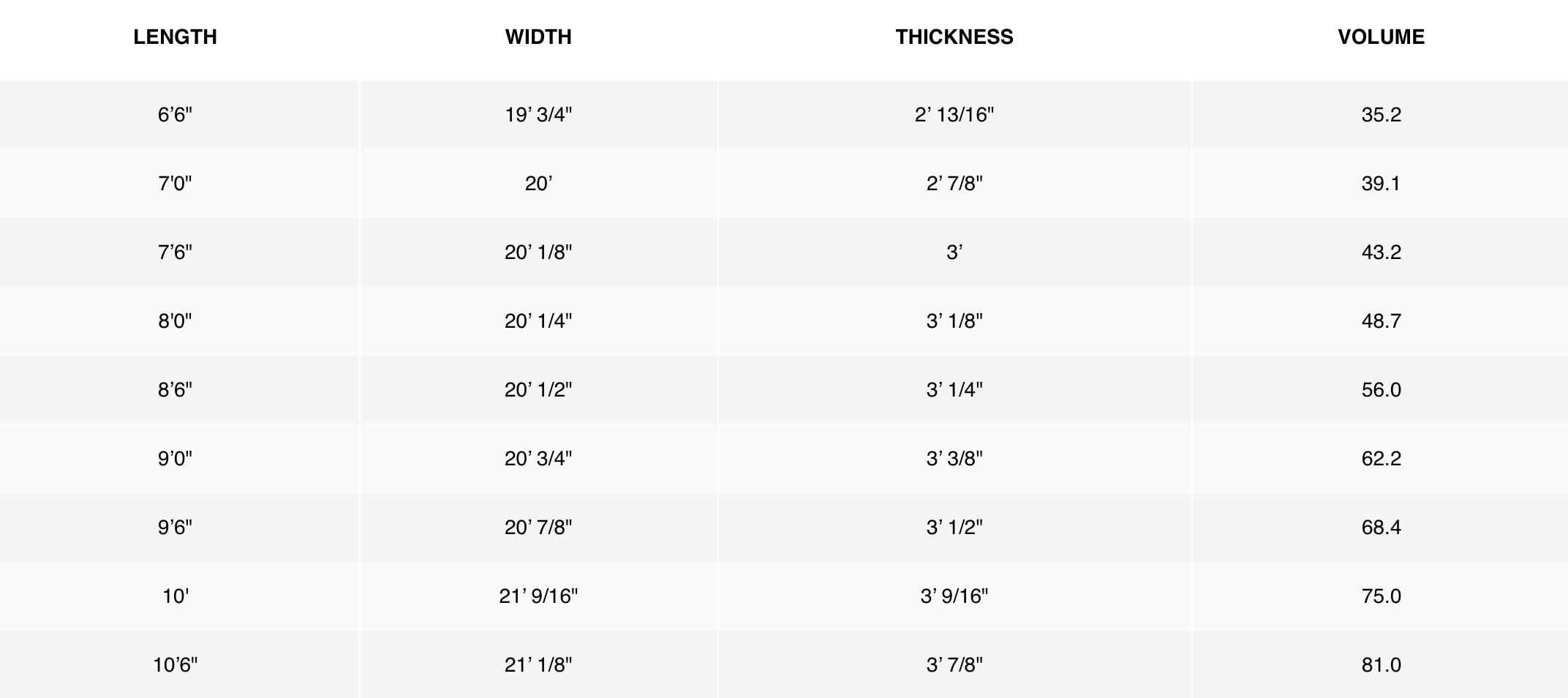
I know volume is just one ingredient in a good board, and that all the other features also determine whether a board is good or bad. Still, I’m interested to hear your thoughts.
My high-performance shortboards (HPS) are in the range of 30–31.5 liters (at 5’10”–6’), and my everyday boards range from 30.5 (at 5’5”–5’9”) to 31.8 liters. How much volume would you recommend for a step-up board (around 6’5”–6’8”) for waves in the 2x overhead range, aiming to get into waves earlier? And what volume would you look for in a proper gun (7’6”–8’6”) where paddle power is critical?
I also wonder: what amount of volume would be too much, even if you keep the rails thin and sharp? And what volume would be too little, making the board too slow to paddle into faster waves?
this is my board quiver, i think you can use it as a reference or maybe not.
i spent a lots of years of trial and error to reach this conclusions of what is best for me in tearms of physical condition and the breaks i surf.
Here is my personal preferences since i am close to your measures, I am 75/78 kgs and 174cms tall i dont follow volume much, but here is my quiver.
i ride a everyday 5.10” x 2.7 x 20 single to double concave square tail board 32 liters with a bit fuller rails on the middle that works great up to overhead surf (any conditions).
i have a 31 liters 6.2 x 2.5 x 19.4 round pin high performance, wide point back, down rails, thin tail , thin nose shortboard that i use when its perfect conditions (barrels or realy clean swell) up to a bit overhead.
STEP UPS -i have two round pin 6.6 x 19.5 x 2.5 boards one with single concave and another single to double. one with fuller rails another with thin rails ( i follow the same philosophy as with the shortboard) one for bigger then overhead and muchy swell or long pointbreaks ,another for bigger then overhrad and perfect waves.
Guns- i have a gun i don’t use it quite often and many times i use it as an adventure board for doing long paddlings for exercise or fun.
So i choose a thicker one is an 9” pin tail 3” thick by 20 wide with a lot of rocker got it second hand (i think the owner changed it because it was only 3 fin instead of quad)
yeah that is a very interesting topic and you are absolutely right. However if I ask for bottom loading numbers for a board I wouldn’t get much from most shapers or surfboard manufacturers. But yes you are right about it, still I´m afraid I have to work with the numbers that are available to me.
I was more looking for how much volume you would add to lets say go from a HPS to a steppe and further to a gun. Taking everything else out of the discussion and talking simply about volume.
I don´t like that “floaty” feeling in a HPS at all, however I have to compromise to have enough board under my chest to paddle fast enough when the waves get bigger. Especially when it gets above 7 foot boards …
ok, i don’t think you add much volume, if you keep your measurements thick and wide when scaling from shortboard to a step up (not a gun) you wont see much difrence in volume.
if i would touch some mesurements would be to make it a little bit less wide. Not much.
why dont you give it a try on aku or s3dx to see what hapens to volume?
If you look at any blank catalog that lists the volume of their blanks you should be able to figure a ratio of volume between various sized blanks. Or just go to a website for any of the larger manufacturers and look through their various models. Most list the volume in their specs. Should be pretty easy to figure how much you need to increase volume in a bigger board. Somebody else has already figured this one out for you.
Even if i use volume for windsurf and wingfoil boards i made i don’t use it for surf but i build quivef for friends. So from your hpsb, for a step up add 4 to 6 foot and around 1/8” at max thickness, more or less same width at center, less at ofo, same rail thickness. For a “real gun” shape must be adjusted to wave you ride with.
A step up is an hpsb adjusted for more powerfull wave. It’s your hpsb stretched so you have a straighter, longer rail for more control at higher speed, drawing longer curves. Add a bit more thickness help to start better in waves that move faster. Less concave.
A gun is a board made for big conditions. I use to make board for big wave for a bro, he have different guns for different waves profiles. Different shapes except the old school vee to belly to spiral vee bottom i use on most big waves boards.
not at all! I found that there is a lot of different thoughts and philosophies coming into play. And just copying something is not my intention. I want to understand why people act the way they do.
I travel all over the world for waves. I surfed many HPS, step ups and grovelers. However I haven´t had the chance to surf one board that stays the same with only lets say one feature (Rocker, Width, Wide Point, Volume,….) changing.
I want to understand why so many step ups are in the 40l range going up from HPS by about 25%, and guns having between 45 and 80 liters. While other shapers only add 1-2 liters in their step ups and increasing volume in a gun only to 45 liters.
and yeah I understand that open ocean big waves need different boards with more volume compared to breaks that break over a shallower reef and tend to be steeper and more powerful.
However as I can´t travel with a huge amount of boards I have to understand the limitations and the necessities.
The location of the wide point, rocker and hard rail edge in relation to the rider’s stance along with fin placement are the biggest keys in my mind to how good a shortboard will be.
I’m in the camp that says the location and amount volume depends on what you’re shaping. If you’re making a classic 8’0 “Pipeliner” template pintail, your volume will be less than an 8’0 roundpin midlength and you’ll be able to ride bigger steeper waves with the pintail, mostly due to the reduced volume in the tail. But the midlength would be more fun in waves with flatter faces. Displacement Hulls have their widepoint and volume ahead of the midpoint of the board and they go very fast in waves that HPS, with their rearward widepoint and volume location, ride well also. The difference between those two is HPS boards are ridden better by back-foot heavy surfers, Hulls tend to be ridden better by front-foot heavy riders that like to walk / adjust their weight, sort of a modern approach to the last of the 60s longboard surfing.
I have 56 liter 7’6” Gordon& smith . Paddles fast . I guess it depends more on your skill level and body weight . I’m 185 pounds 71 years old ! Just getting back into surfing after 20 year break . Also have a 42 , 50 , 38 , 80 and 88 liter boards